Xiaomi Lost the Prepayment Case on Appeal? Is What AI Searches Fact or Rumor?
Using the rumor that Xiaomi lost the prepayment case on appeal as an example, this article analyzes how AI web search, lacking independent judgment, can become a rumor amplifier, highlighting the importance of information discernment in the AI era.
Recently, I saw a message posted by a group member in a chat group:
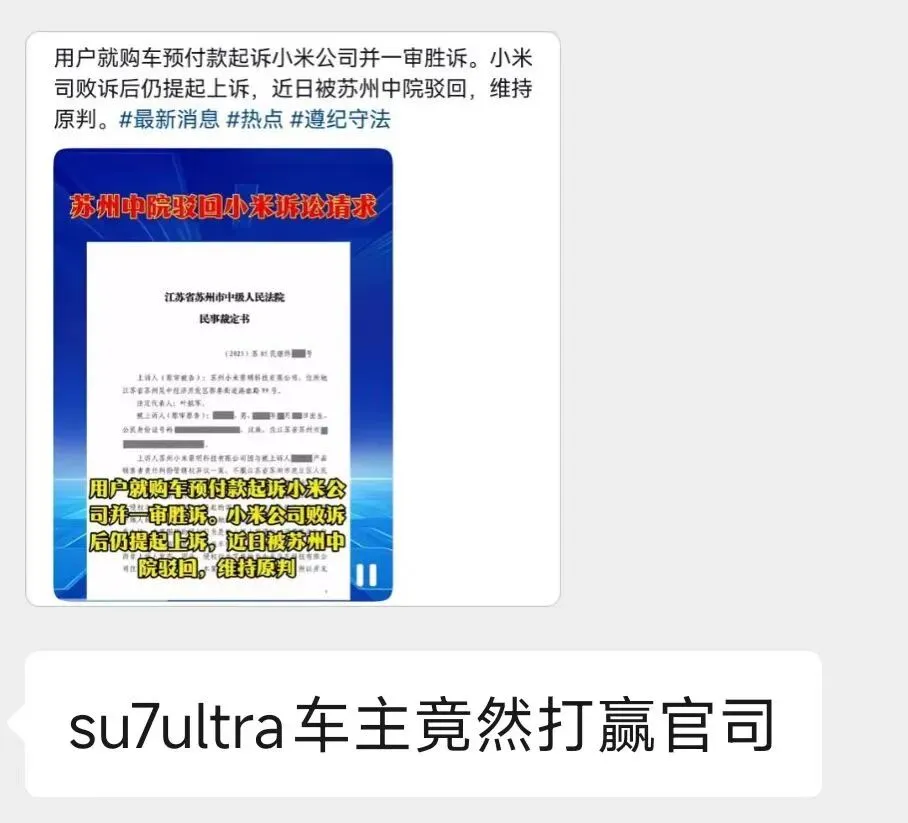
Oh? So they already won?
Really that fast?
Rumors — really that fast?
*This article represents the author’s personal views only and does not constitute legal advice or opinion.
1. Judgment? Ruling!
The Xiaomi SU7 Ultra was released on February 27, 2025 — less than 8 months ago. Even if the car owner filed a lawsuit right after placing the order, as an industry insider, everyone knows:
Appeals don’t move that fast (laughs).
Clicking on the screenshot to take a closer look, sure enough — it’s a ruling.
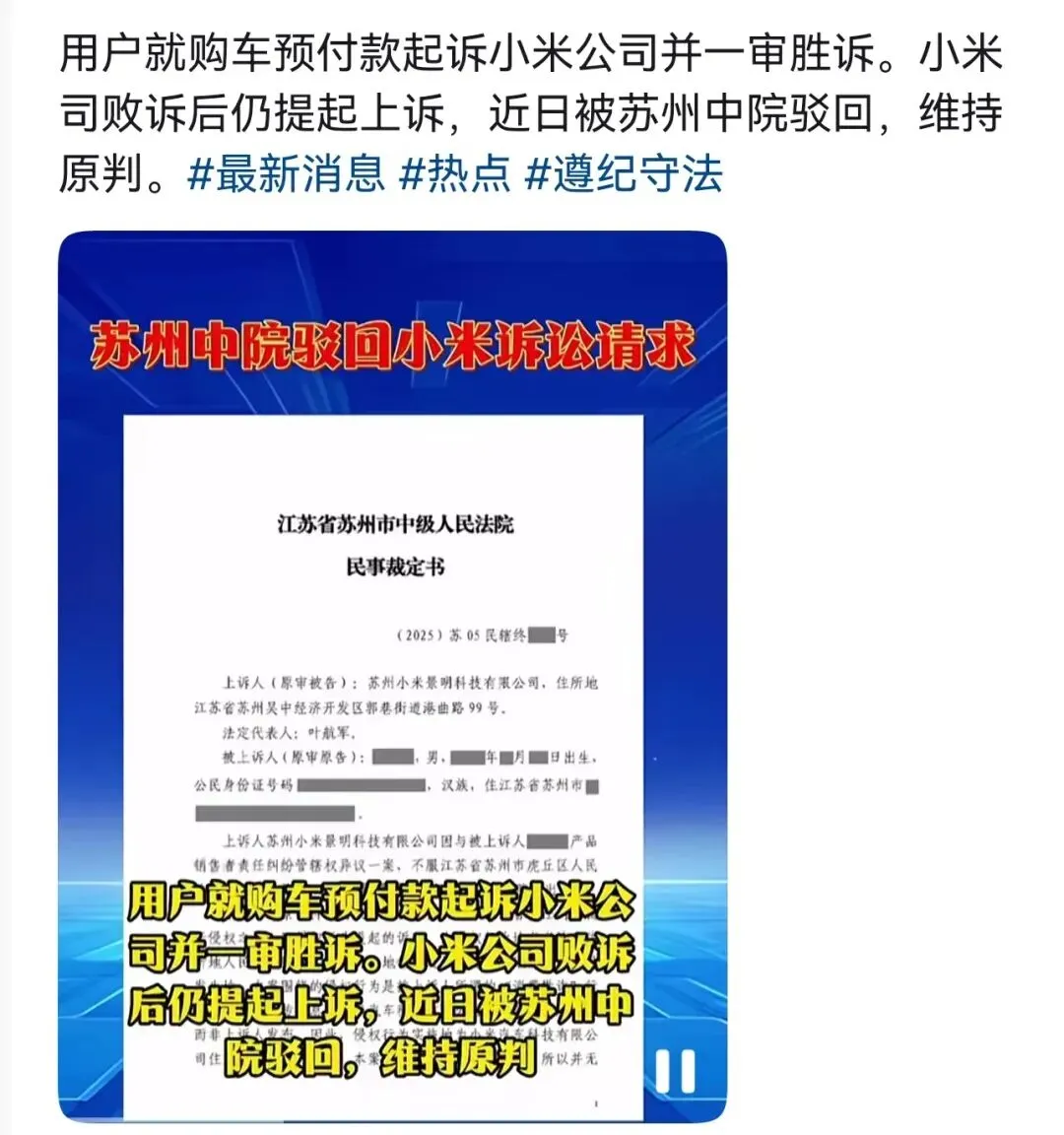
This is a ruling on a jurisdictional objection.
In layman’s terms:
The car owner sued Xiaomi in Suzhou Huqiu District Court. Xiaomi argued that the case should not be heard in Huqiu District Court and applied for a change of venue. Huqiu District Court denied Xiaomi’s application. Xiaomi appealed to the Suzhou Intermediate Court, which ultimately upheld the original ruling, affirming that Huqiu District Court has jurisdiction.
Therefore, this entire process has nothing to do with winning or losing the case itself. The so-called “victory” is complete nonsense.
The actual first-instance trial is still a long way off.
2. AI Aids Rumor Propagation
Whether this “news” was spread by netizens who “don’t understand the law” or those with “ulterior motives,” the involvement of AI has undeniably added fuel to the fire of rumor dissemination.
This group member later posted another image:
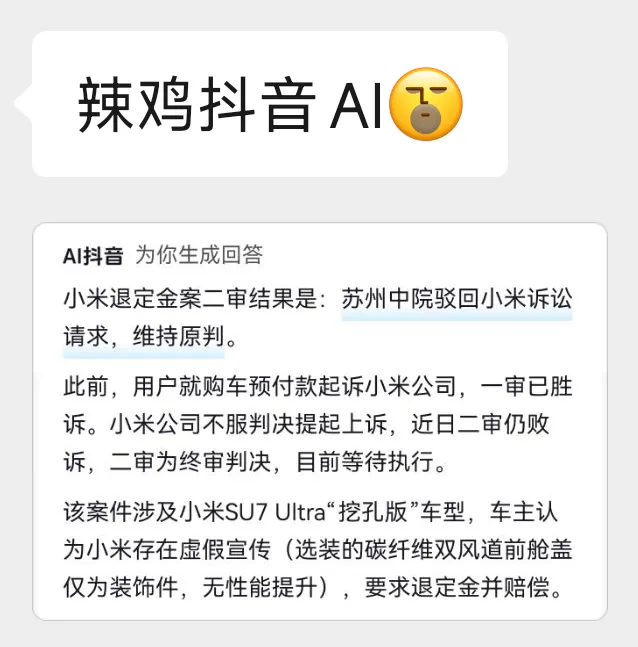
When asked about “the outcome of the Xiaomi deposit refund case on appeal,” Douyin’s AI directly accepted the aforementioned rumor, confidently declaring that Xiaomi lost on appeal and was even “awaiting enforcement.”
Imagine if you hadn’t watched the video in detail, hadn’t seen the fact-checking comments beneath it, or hadn’t looked up related fact-checking videos based on the question.
Simply seeing this AI response alone — it would indeed be misleading.
3. Connected AI Is Often Little More Than a Rumor Amplifier
Using AI to spread rumors is nothing new — it has even become a global challenge.
Especially when everyone is obsessed with “AI web search” and believes “AI web search = correct answer,” rumors have been “thriving.”
Global AI error rates are surging in 2025
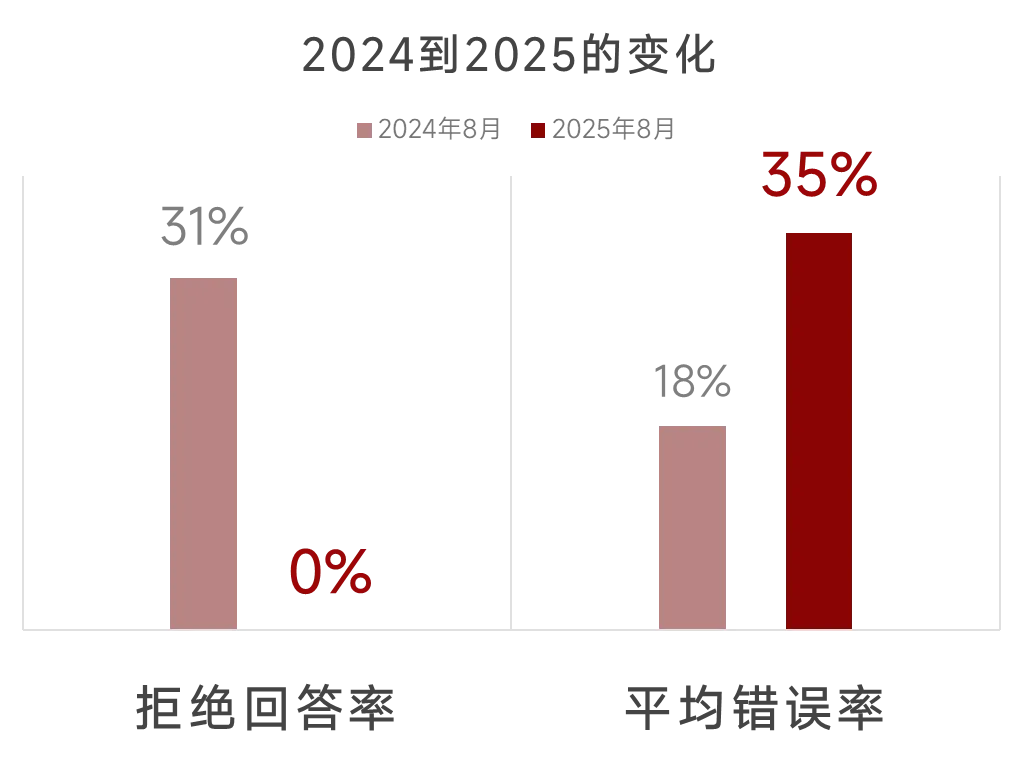
According to a survey by the overseas organization NewsGuard on AI output information in 2024 and 2025, the error rate of major overseas AI model applications is mostly increasing.
Although domestic models are not included in the survey, frequent users will certainly have felt this too.
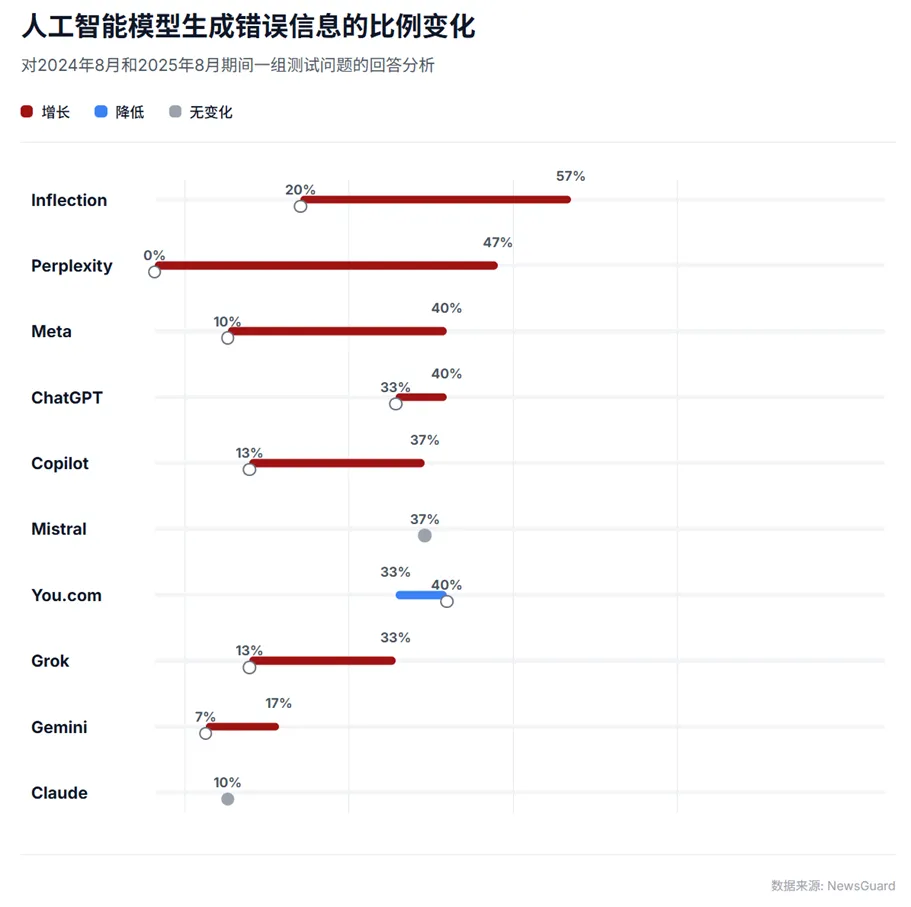
The reason is actually very simple.
In the past, when AI encountered knowledge outside its training data, or when users asked about the latest news, depending on the system prompt, it would either directly state that it didn’t know or make something up (i.e., “hallucination”).
Users began to complain.
AI companies saw this and thought, “This won’t do,” and introduced web search agents.
Now, as soon as the AI feels its knowledge might be even slightly insufficient, it immediately searches the internet for answers.
The upside: AI’s refusal-to-answer rate dropped from 31% in 2024 to 0%.
The downside: the average error rate doubled.
Connected AI Only Integrates, It Does Not Judge
There are two somewhat “incorrect” beliefs about AI web search that are quite popular.
One is that it’s “based on big data,” and the other is that it “reduces AI hallucinations.”
But what is the actual process of AI web search?
The AI takes the user’s question, passes it to a search engine for keyword search, reads some pages, organizes the content from those pages, and replies to the user.
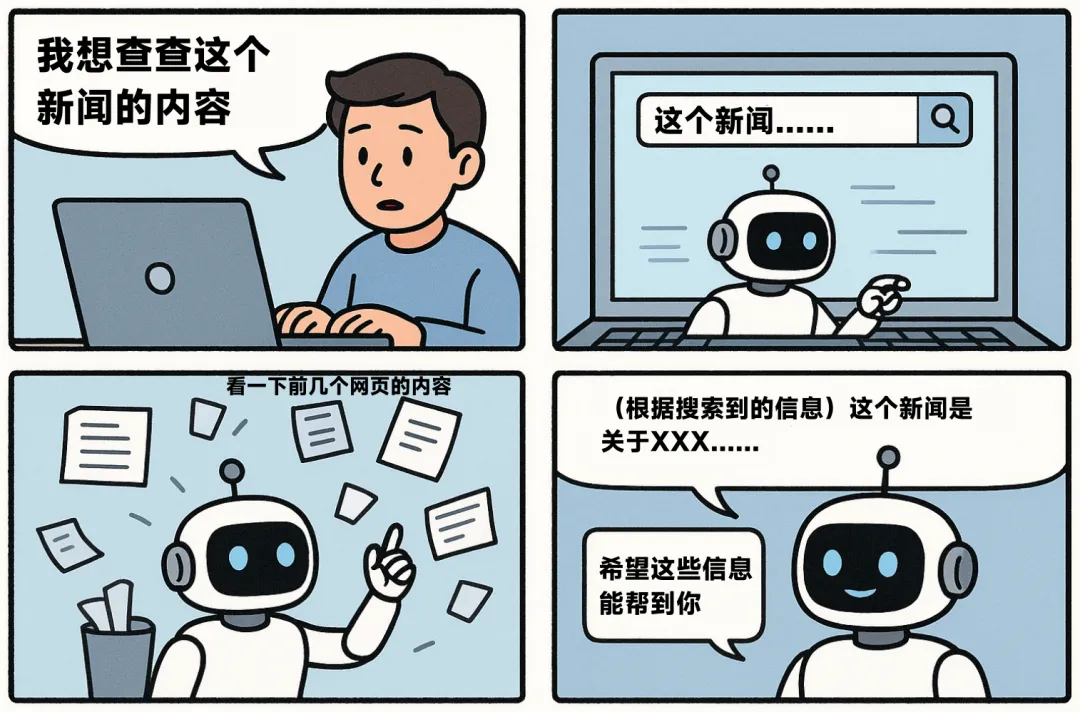
The process is as simple as that — and full of all sorts of problems.
First, the AI reads a limited number of pages — only a portion of the web content returned by the search engine.
When we search using a search engine (like Baidu, Bing, or Google), we usually first judge from the title and snippet whether the content is what we need, whether it’s junk written by clickbait writers, or whether it’s AI-generated traffic-bait.
But AI doesn’t do that. The AI simply reads whatever the search engine returns and takes in whatever content is available. If the returned content contains a large amount of rumor information, the AI will “accept it all.”
So, AI web search responses are not based on any “big data” — they are actually based on “small data,” even smaller than what we would see searching on our own.

At least when we research, we don’t jump to conclusions based on just the top 10 search results.
Another problem: to avoid the “chicken and egg” issue, connected AI typically has a limiting prompt:
“Please organize the following content and reply to the user’s question.”
This prompt ensures that when the AI’s own knowledge conflicts with online information, it prioritizes the online information, avoiding the problem of “AI using its own outdated or incorrect knowledge to deny new online information.”
This means the AI does not (and actually cannot) independently judge the truthfulness of this information — it simply synthesizes the content from various web pages, acting as a “mindlessporter.”
Take the Douyin AI example above: when a user searches for a question, if the “first few videos” the AI finds just happen to be about “Xiaomi losing the case,” then the AI will naturally reply that “Xiaomi lost the case.”
The AI does not use its own legal knowledge to assess the accuracy of these found “Xiaomi lost” videos. What it does, and all it does, is “synthesize and summarize.”
So, even if this is something a first-year law student could identify as problematic, the AI won’t correct it, let alone remind users to be discerning.
Therefore, connected AI not only fails to fully “reduce hallucinations” — it can even be manipulated by “bad actors” to further amplify “hallucinations” and even rumors.
4. Spreading Rumors Has Become Easier in the AI Era
At this point, you might ask: so connected AI is basically useless?
Yes, indeed.
At least in terms of fact-checking, its reliability is completely insufficient. That’s why I’ve never liked the connected-to-web feature and don’t actively enable AI web search.
Check the AI’s cited sources? What if all the cited sources are wrong?
I still prefer searching online myself.
But unfortunately, major platforms are now all integrating AI, even adding AI summarization features to search functions, placing the summary results at the top of search results.
When users search for something, the first thing they see is the “AI summary” conclusion.
In today’s era of “fragmented reading,” this feature indeed caters to many people’s desire to “save time.”
But the incorrect conclusions it summarizes are not just common — they’re the norm nine times out of ten.
This also raises another issue:
Misleading, attacking, and defaming others has become easier.
In the past, even if people’s information sources weren’t official media, they were often influential figures (commonly known as “big Vs”), and this information would at least have gone through some filtering.
Even if people didn’t get information from “big Vs,” they would see various comments during their own search process and might learn about different situations and perspectives.
But now, under the vigorous promotion of “AI’s advanced nature” by many self-media, a large number of ordinary users subconsciously believe:
“What AI says is correct.”
This leads them to directly ignore the actual content of search results and rely entirely on the AI’s summary response.
This is a very frightening signal.
It means that you only need a certain number of fake accounts to post rumor information. As long as this information can be captured by AI during summarization, it can successfully contaminate all subsequent users who query the same question. If users further spread or endorse the rumor, it will in turn increase the weight the AI gives to that rumor, forming a perfect “rumorcycle.”
Even without human intervention — because of the limit on the amount of content returned — the AI may only capture the rumor and not the fact-checking content, leading to “permanent contamination.”
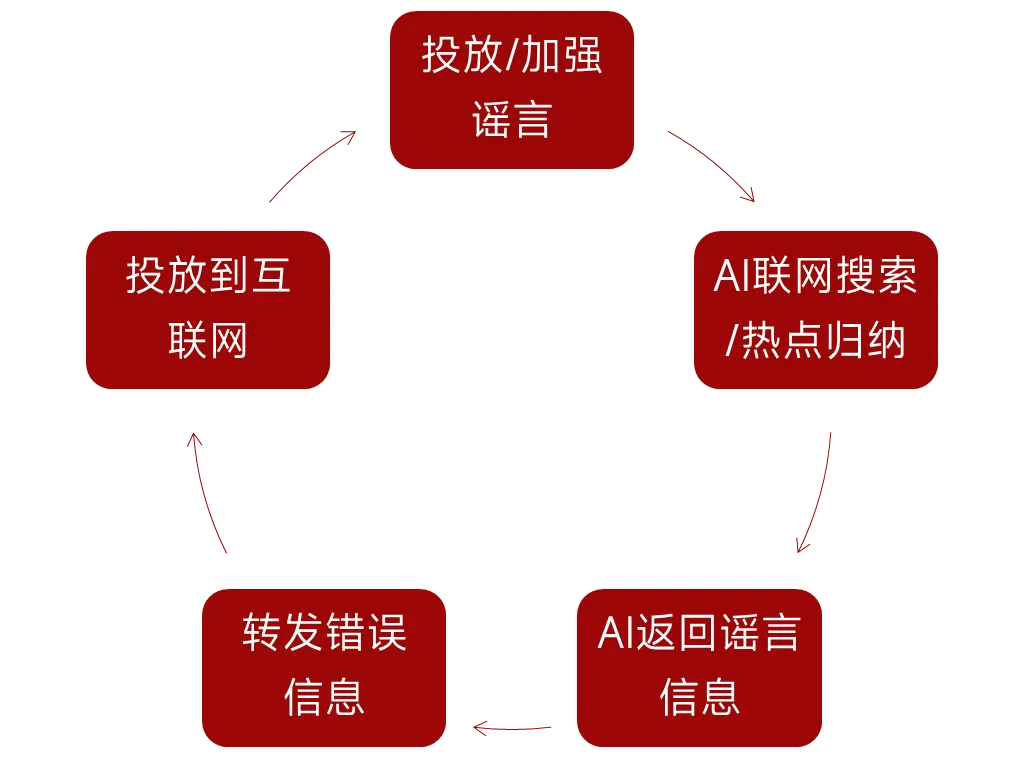
In the past, “AI poisoning” referred to contaminating training datasets — a high-cost, long-cycle process.
But that level of effort is no longer necessary.
Now, by simply exploiting the vulnerabilities of the AI web search mechanism, platform traffic KPIs, and users’ desire to “take shortcuts,” one can achieve more efficient “unfair competition” or even “historical revisionism” than ever before.
And it’s more covert and harder to investigate.
If I just wanted to popularize legal knowledge, I could naturally cite the penalty standards for “unfair competition.”
But honestly, if the fake accounts claim “I’m ignorant of the law” or “I was just trying to bypass a platform’s filtered term (and thus polluted the data with a wrong legal entity)…”
It’s really difficult to handle.
5. Final Thoughts
Of course, AI’s role in rumor creation is not limited to “summarization.” From “AI-generated images” to “AI-generated videos,” it’s clear that “rumors” will inevitably become a constant presence in our lives in the foreseeable future.
Limiting AI development is neither realistic nor advisable. Facing rumors, we should not resort to a “one-size-fits-all” approach and completely ban AI use.
But at the very least, we should maintain a “healthy skepticism” toward everything and try to “think more.”
First, start by not believing that “AI is always right.”
After all, am I the First Emperor of China?

(Image generated using Nano Banana)