Will Publishing 'Danmei' Overseas Lead to 'Distant-Water Fishing'? What About Games?
Chinese citizens publishing adult danmei content on overseas platforms face criminal prosecution under territorial jurisdiction; the gaming industry faces similar risks of cross-regional enforcement and outdated obscenity sentencing standards.
Recently, multiple criminal cases involving the creation of “danmei” (BL) themed online literature have drawn widespread attention.
According to reports, over 50 creators who posted on an overseas adult literature platform have been investigated and dealt with according to law, distributed across multiple provinces in China. Some cases have already been adjudicated, with sentences ranging from probation to 4 years in prison. Multiple other cases are still under trial.
As the case is mainly investigated by a county public security bureau in Anhui Province, and the suspects are跨地域 distributed, it has sparked heated discussion about whether this operation constitutes “distant-water fishing” (跨省抓捕 for financial gain) and why the sentences are so severe.
What is “distant-water fishing”?
Why are the sentences so harsh?
Let’s take a look below.
After all, next time, games might face the same risk.
This article represents only the author’s personal views and does not constitute legal advice or legal opinion.
I. What is “Distant-Water Fishing”?
On December 16, the People’s Daily published an editorial titled “The Black Hand of ‘Distant-Water Fishing’ Style Illegal Law Enforcement Must Be Cut Off,” which defined “distant-water fishing”:
“Distant-water fishing” mainly refers to illegal跨地域 arrests of private entrepreneurs, and the freezing, or even transfer, of assets of enterprises and individuals from other regions. Such behavior seriously infringes upon the legitimate rights and interests of private entrepreneurs, erodes their confidence in development, damages the rule of law, and pollutes the local business environment. Thunderous measures must be taken to eliminate it in accordance with the law.
— Zhang Jinshan, People’s Daily Commentary
This behavior appears on the surface as “跨省 arrests,” but its essence is a variant of “profit-driven law enforcement.”
“Profit-driven law enforcement” is not a new concept. As early as 2021, public security authorities explicitly issued the “Seven Regulations Prohibiting Profit-Driven Law Enforcement,” in which Article 6 stipulates:
- Strictly follow the procedures for异地 case handling cooperation, implement centralized receipt and review requirements, improve dispute resolution mechanisms for case jurisdiction, nature determination, and other issues, and prohibit illegal competition for case jurisdiction with confiscation income.
Why “profit-driven law enforcement”?
Because, according to the “Supreme People’s Court’s Several Provisions on the Enforcement of Property Penalties” (2009):
Article 7: All enforced property shall be turned over to the state treasury.
Confiscated income and fines in criminal cases go to the local treasury of the jurisdiction where the case is handled.
Given the generally high local fiscal pressure, this undoubtedly lays the groundwork for some regions to be keen on competing for case jurisdiction. Some local law enforcement departments, under the guise of “combating crime,” cast their gaze beyond their borders with ulterior motives, trying to generate revenue through异地 case handling.
However, regarding jurisdiction, according to Article 15 of the “Procedural Regulations for Criminal Case Handling by Public Security Organs” (2012):
Article 15: Criminal cases shall be under the jurisdiction of the public security organ in the place where the crime was committed. The place where the crime was committed includes the place where the criminal act occurred and the place where the criminal result occurred.
The place where the criminal act occurred includes the place of implementation, preparation, initiation, transit, and conclusion of the criminal act, as well as other places related to the criminal act; if the criminal act is continuous or ongoing, the places where the criminal act is continuously or ongoingly committed are all considered the place where the crime was committed. The place where the criminal result occurred includes the place where the criminal target was infringed, and the place where the criminal proceeds were actually obtained, concealed, transferred, used, or sold.
Considering that the focus should primarily be on the “perpetrator,” achieving “distant-water fishing” is not easy.
But “fortunately,” a large number of daily business activities now rely on the internet, and Article 16 has further provisions for internet cases:
Article 16: For crimes committed targeting or using computer networks, the public security organs in the location of the website server used for committing the crime, the network access point, the location of the website establisher or manager, the location of the infringed computer information system and its manager, and the location of the computer information system used by the perpetrator or victim during the crime may exercise jurisdiction.
Therefore, some localities cleverly utilize the “victim’s location” clause by setting up a local “victim” to file a report, giving the local police the basis of the “victim’s location,” thereby “legally” conducting arrests in other provinces.
In the current case, it is rumored that a key witness in the judgment has the same name as a certain employee of the local public security organ. This suspicious coincidence has led the public to question whether the case involves “distant-water fishing.”
II. Why Are “Obscenity” Cases Sentenced So Heavily?
Whether it’s writing or purchasing代理, whenever a case is made public, it always triggers online discussion:
This batch of cases resulted in sentences ranging from probation to four years, with the highest fine being over 1.84 million yuan;
In 2018, “Tian Yi,” a danmei novel author, was found to have sold over 7,000 copies of various obscene books online, illegally profiting 150,000 yuan. An Anhui court convicted her of the crime of producing and selling obscene articles for profit, ultimately sentencing her to 10 years and 6 months in prison, with a fine of 50,000 yuan.
In 2022, Li, a shop owner at Guangzhou Animation Star City, was suspected of smuggling obscene publications (procuring for customers from a Taiwanese book dealer), totaling 3,589 books. The Guangzhou Intermediate People’s Court convicted him of the crime of smuggling obscene articles, sentencing him to 11 years in prison and a fine of 200,000 yuan.
Online discussion once reached a fever pitch: “Writing danmei is punished more severely than rape.”
Let’s not discuss the specific sentencing of “rape” here. Although the above cases are all related to “danmei,” it is not only “danmei” that receives such heavy sentences.
In Case (2020) Lu 02 Xing Zhong 663, the defendant Gong (male) self-built over 20 “BT seed” and “magnet link” websites, crawling “seeds” from the internet for users to download. The public security organs searched for keywords to download certain “seeds” for investigation, finding a total of 588 obscene videos among the numerous seed files on the website.
The first-instance verdict was 10 years in prison.
On appeal, considering that these websites were merely “seed” sites, and although they contained BT seed information for some obscene videos, Gong was not the producer or direct provider of the obscene videos, the sentence was ultimately reduced to 3 years in prison.
Why are “obscenity” related cases sentenced so heavily?
All because of three judicial interpretations.
One is the “Supreme People’s Court’s Interpretation on Several Issues Concerning the Specific Application of Law in the Trial of Criminal Cases of Illegal Publications” (1998), from 26 years ago.
Another is the judicial interpretation from 20 years ago: “Interpretation of the Supreme People’s Court and the Supreme People’s Procuratorate on Several Issues Concerning the Specific Application of Law in the Trial of Criminal Cases of Producing, Reproducing, Publishing, Selling, and Disseminating Obscene Electronic Information Using the Internet, Mobile Communication Terminals, and Voice Message Stations” (2004).
And the last is the judicial interpretation from 10 years ago: “Interpretation on Several Issues Concerning the Application of Law in the Trial of Criminal Cases of Smuggling” (2014).
I have created simple comparison tables based on these three interpretations:
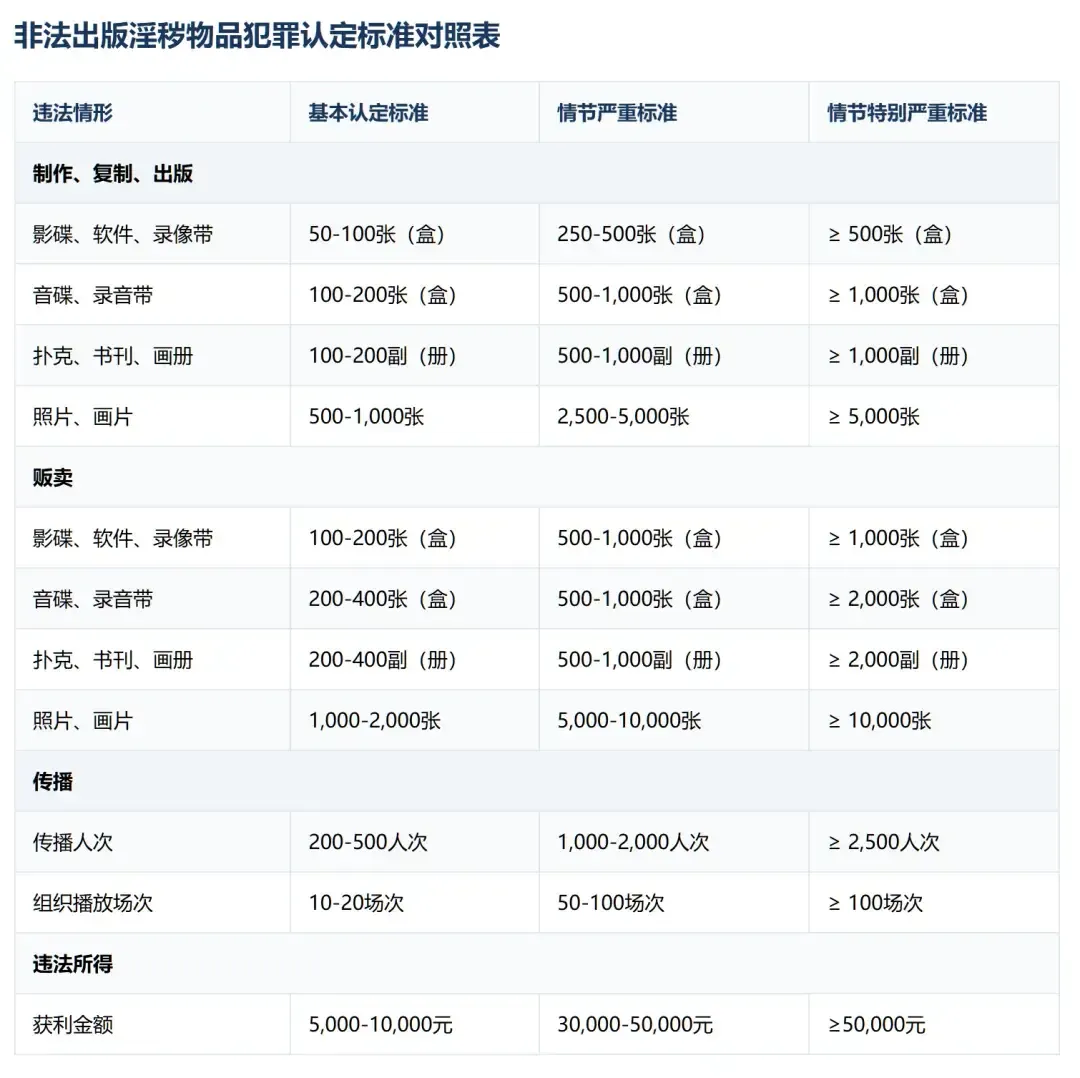
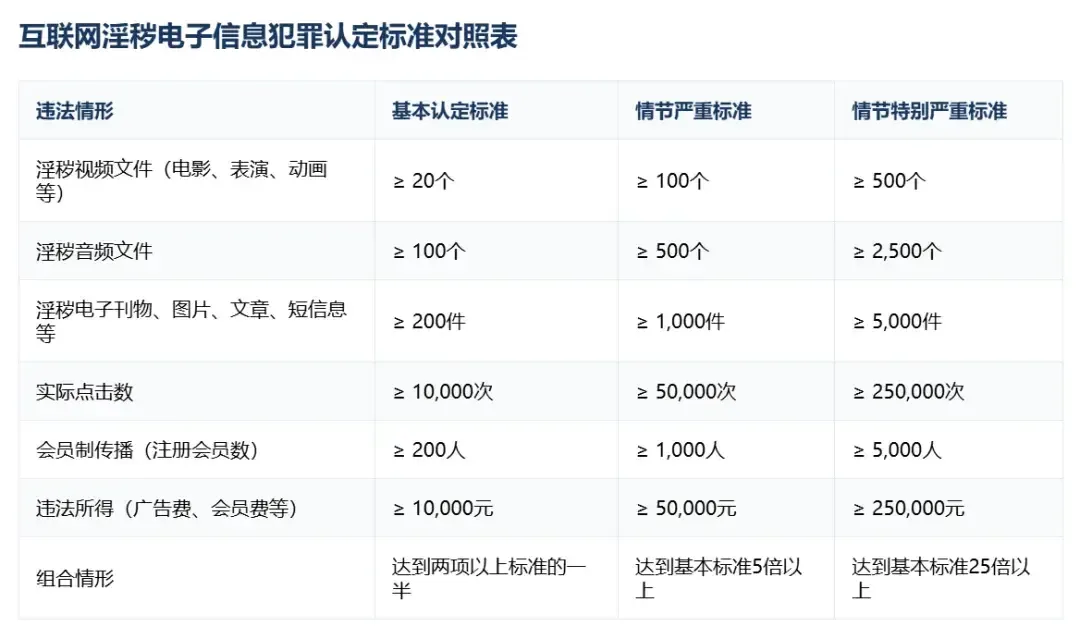
Serious circumstances: Fixed-term imprisonment of not less than 3 years but not more than 10 years, and a fine (1-5 times); Especially serious circumstances: Fixed-term imprisonment of not less than 10 years or life imprisonment, and a fine (1-5 times) or confiscation of property.
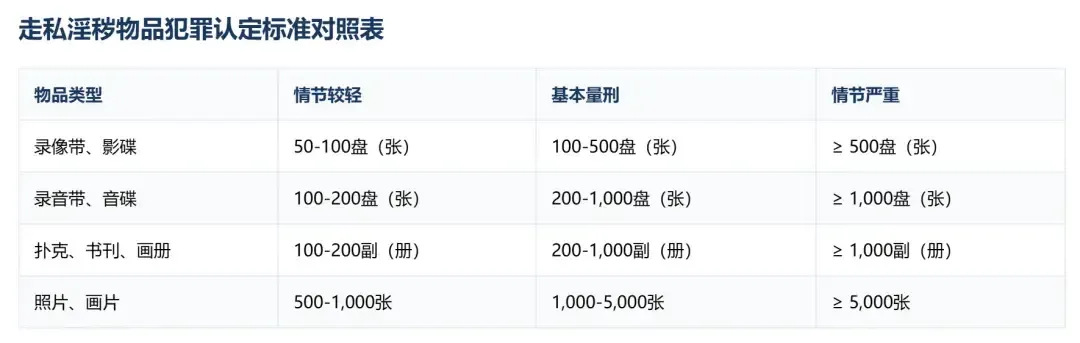
Minor circumstances: Fixed-term imprisonment of not more than 3 years, criminal detention, or public surveillance, and a fine; Basic sentencing: Fixed-term imprisonment of not less than 3 years but not more than 10 years, and a fine; Serious circumstances: Fixed-term imprisonment of not less than 10 years or life imprisonment, and a fine or confiscation of property.
In case (2020) Lu 02 Xing Zhong 663, although there were only 588 obscene videos, this exceeded the upper limit of 500, so the first-instance sentence was 10 years.
In the “Tian Yi” case, because over 7,000 copies of obscene books were sold, exceeding the upper limit of 2,000, the sentence was 10 years.
In the “Animation Star City” case, because 3,589 copies of obscene books were smuggled, exceeding the upper limit of 1,000, the sentence was 11 years.
All of these verdicts are consistent with judicial interpretations from ten years ago, or even the last century.
Therefore, these sentences are not “unjust.”
But is “not unjust” sufficient?
Twenty years ago, the number of internet users was only 87 million.
 (Source: NetEase Tech, CNNIC 14th Statistical Report on China’s Internet Development)
Twenty years later, the number of internet users has reached 1.1 billion.
 (Source: CNNIC 54th Statistical Report on China’s Internet Development)
This means that 20 years ago, disseminating 5,000 copies of obscene content could affect one in ten thousand internet users. Today, the same quantity can only affect one in two hundred thousand.
Technological development has brought entirely new methods and speeds of dissemination, but the standards for criminal sentencing seem to have stagnated in the past.
When we turn our attention to other crimes, this sense of时代错位感 becomes even more pronounced.
Take theft, for example. Its sentencing standard was adjusted as early as 2013:
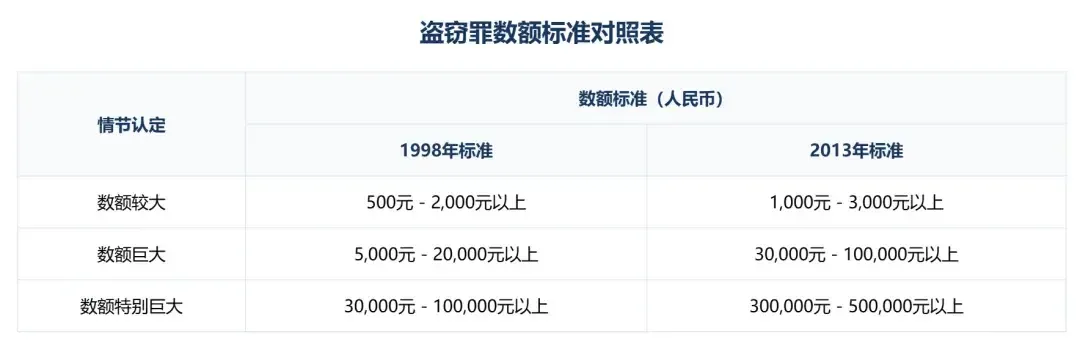
Large amount: Fixed-term imprisonment of not less than 3 years but not more than 10 years, and a fine; Huge amount or other especially serious circumstances: Fixed-term imprisonment of not less than 10 years or life imprisonment, and a fine or confiscation of property.
At that time, the Supreme People’s Procuratorate published an “Interpretation of the ‘Supreme People’s Court and Supreme People’s Procuratorate’s Interpretation on Several Issues Concerning the Application of Law in the Trial of Criminal Cases of Theft’” mentioning the reasons for the change:
The main considerations: As a common property crime, the punishment of theft should consider the economic and social development and the growth of the people’s income, as well as the people’s sense of property security, the actual public security situation, the overall trend of penalty application, and coordination with relevant judicial interpretations. Therefore, this paragraph appropriately raises the threshold for theft crimes based on the growth of per capita income; and to reflect the principle of proportionality between crime and punishment, the standards for “large amount” and “huge amount” have been significantly raised.
Because the average income in society has increased, regardless of whether the victim’s personal income is high or low, the thief can steal more money before receiving the same level of punishment.
This is the “principle of proportionality between crime and punishment.”
Back in 2013, the national per capita disposable income was only 18,311 yuan.
In other words:
Stealing someone’s total disposable income for about more than 16 years is considered equal, in terms of crime and punishment, to sharing 500 pornographic videos online.
The punishment fits the crime — both are “proportional.”
Even as of 2023, the national per capita disposable income has only just approached 40,000 yuan.
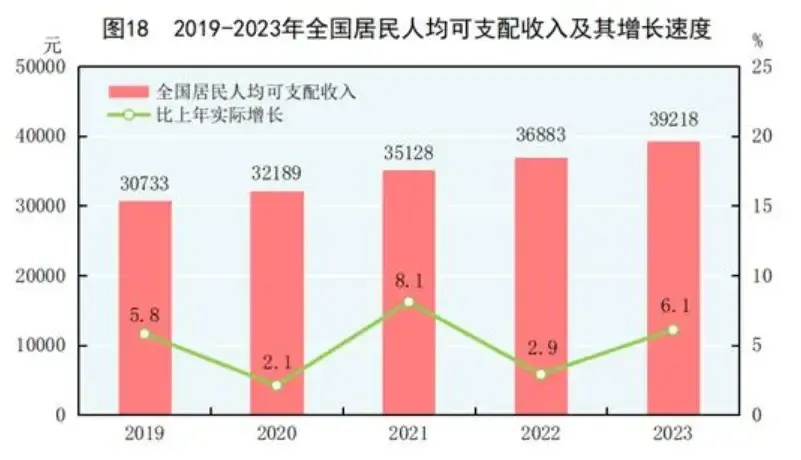 (Source: 2023 Statistical Bulletin on National Economic and Social Development)
This ratio has barely reached:
Stealing 8 years’ total disposable income = sharing 500 pornographic videos
III. Overseas is Never a “Safe Zone”
In this incident, many authors claimed that due to the tightening of “danmei” policies domestically and the crackdown on pornographic content in China, they moved to overseas platforms.
They believed that targeting an overseas audience would exempt them from punishment.
However, as discussed in my previous article:
Want to Replicate “Drowned by a Beauty”? Some Legal Knowledge Needs to Be Learned First →
This mindset reveals a common legal misconception: believing that targeting an overseas audience can circumvent legal sanctions.
The reality is just the opposite — China’s criminal law has long had clear provisions on this.
China’s criminal law follows “territorial jurisdiction” + “nationality jurisdiction”:
Article 6 [Territorial Jurisdiction]: Anyone who commits a crime within the territory of the People’s Republic of China shall be subject to this Law, except as otherwise specifically provided by law. This Law also applies to anyone who commits a crime on board a ship or aircraft of the People’s Republic of China. If either the act or the result of a crime occurs within the territory of the People’s Republic of China, it is deemed to have been committed within the territory of the People’s Republic of China.
Article 7 [Nationality Jurisdiction]: Any citizen of the People’s Republic of China who commits a crime prescribed by this Law outside the territory of the People’s Republic of China shall be subject to this Law, but if the maximum punishment prescribed by this Law is fixed-term imprisonment of not more than three years, it may not be investigated. Any state functionary or member of the armed forces of the People’s Republic of China who commits a crime prescribed by this Law outside the territory of the People’s Republic of China shall be subject to this Law.
— “Criminal Law”
That is, as long as you are a Chinese citizen, if you produce or disseminate obscene content, whether domestically or overseas, regardless of which platform you choose or which country’s audience you target, you will bear criminal liability.
If you commit a crime, you will inevitably be prosecuted.
Especially when you’re still within Chinese territory.
IV. Will the Gaming Industry Be Next?
The gaming industry has previously been identified online as a primary target for “distant-water fishing.” A series of attention-grabbing cases from 2023 to the present paint a grim picture of the challenges facing this industry.
In 2023, Youyou Interactive’s Texas Hold’em app was deemed a “gambling software.” Police from the Xinzuoqi Banner of Hulunbuir City traveled over 1,500 kilometers to bring Beijing-based game company personnel back for investigation. During the process, the arrested individual Xing Yanjun died abnormally in the designated living quarters. On December 6, 2024, the Xin Barag Zuuo Banner Public Security Bureau in Inner Mongolia made a decision to dismiss the case against the “Competitive Alliance Texas Hold’em APP suspected of operating a casino,” citing no criminal facts.
In September 2023, the Bixin and Yuer apps under Shanghai Yitan Technology were deemed gambling due to their互动抽奖 features, involving over 800 million yuan. Subsequently, the Taoyuan County Public Security Bureau in Changde, Hunan, took action in December, not only criminally detaining multiple employees but also freezing up to 420 million yuan of the company and its parent company, Play Dream Group. The case is currently under investigation.
In early 2024, the Guigang City Bureau of Culture, Radio, Television, and Tourism in Guangxi publicly disclosed three administrative penalty decisions (Gui Wen Zong Fa Zi [2023] 38-1, 38-2, 38-3). The decisions stated that on September 8, 2023, the Guigang City Bureau of Culture, Radio, Television, and Tourism received a transfer of an illegal publication case from the Gangbei Branch of the Guigang City Public Security Bureau, requiring the investigation of the illegal publication activities operated by Guilin Yunmeng Huyu Network Technology Co., Ltd., Nanning Xingji Yunyou Network Technology Co., Ltd., and Guigang Juwantianxia Network Technology Co., Ltd. During this period, personnel from multiple involved companies (except the ones ultimately fined) were also taken to the area for investigation. Ultimately, the Guigang City Bureau of Culture, Radio, Television, and Tourism fined the three companies 22,110,568 yuan, 103,874,486 yuan, and 1,931,339 yuan respectively.
…
However, these are actually “near-shore fishing” within the territory.
But as fiscal revenue pressure increases, combined with the tightening of the version number policy and the “game出海潮” driven by intensified domestic market competition, law enforcement attention may turn further afield in the future.
Currently, on overseas game platforms, there is no shortage of games with Chinese as their primary language, containing adult content or special gameplay. Some developers and publishers even publicly conduct Chinese-language marketing and establish QQ groups to communicate with players.

This operational model is strikingly similar to that of the recently investigated “danmei” creators — using overseas platforms to evade regulation while targeting Chinese-speaking user groups.
This recent “danmei” case should also serve as a wake-up call for those creating such games in China:
Overseas platforms have never been “lawless territories.”
Regardless of where the game sales platform is located, where the production and operating companies are based, or whether “patches” are included within the game.
As long as you are here, the sword of criminal punishment hangs over your head, ready to cut down any criminal hand at any time.
V. Conclusion
This criminal case involving “danmei” themed creation reveals the complexity of internet-era legal supervision and the potential risks of跨地域 law enforcement. This phenomenon also reflects the misalignment between judicial practice and legal provisions on the one hand, and technological development and social change on the other.
The life of the law lies in keeping pace with the times. In this era of digital浪潮, we need to re-examine the actual social harm of criminal behavior in the new era, against the backdrop of people’s generally increased acceptance.
The dissemination of obscene and pornographic content should be sanctioned, but sentencing standards should also consider the new characteristics brought about by technological development.
Only then can we better “reflect the principle of proportionality between crime and punishment.”
But I’m afraid, given the declining birth rates,
The crackdown on “pornographic” content will only intensify.