Why AI's Service-Sector Productivity Explosion Is Useless
Critique of AI-driven service-sector overcapacity disconnected from consumer reality, analyzing how AI layoffs eliminate consumers, one-person companies become unemployment buffers, and the digital world's new-era subsistence farming dilemma.
Open any developer community, news site, or social platform in 2026, and you’ll feel an almost “manic” productivity explosion.
Thanks to the iteration of foundational LLMs and the widespread adoption of Vibe Coding (writing code through natural language), ordinary people are no longer satisfied with “copy-paste office work” with AI on web pages. They’re installing Claude Code, Codex, Antigravity, using AI Agents to build all sorts of applications.
In the time it takes to drink a coffee, you can “talk” your way to several app demos and launch them.
The massive influx of short videos, articles, and daily/work apps flooding the internet every day is filling up service providers’ storage clusters at an exponential rate, forcing them to purchase new storage equipment.
“Creators” have teamed up with NVIDIA to boost SK Hynix’s sales and stock prices.
While simultaneously dragging down the DIY market.
Of course, AI applications in the physical world have tremendous social value. When machine vision optimizes agricultural planting, when embodied AI improves factory production line yields, when underlying computing power accelerates the discovery of new materials and drugs—these technologies are genuinely reducing humanity’s physical cost of living.
But in the service sector—especially in code, content, and digital productivity tools—these purely mental and virtual domains—the current AI-driven productivity explosion appears utterly hollow.
The supply-side frenzy in the virtual industry has completely detached from real consumer demand.
This false prosperity, built on near-zero marginal costs, faces a reality lacking both purchasing power and consumer confidence.
- This article represents only the author’s personal views and should not be considered legal advice.
I. “Lottery Inflation” and “Attention Deflation”
In the past, whether developing software, polishing an article, creating a high-resolution image, recording a soundtrack, or producing a film—even a short video—required immense intellectual effort and substantial capital, labor, and time. High barriers naturally filtered the market, keeping the vast majority of low-quality supply out.
But since AI entered the scene, compared to human labor costs, the almost “free” token fees have shattered the marginal cost of service-sector production, driving it infinitely close to zero.
A massive drop in production costs means a massive drop in trial-and-error costs. Creators have inevitably fallen into a “lottery mentality.”
Everyone knows full well that the code batch-produced by AI and the short videos stitched together are homogeneous, mediocre, and “obviously AI-generated.”
“But, what if?”
Everyone is gambling on a tiny probability, hoping one of their products might accidentally strike a chord with the public, go viral, and cash in on the traffic.
When everyone is frantically issuing “lottery tickets” at near-zero cost, the total supply of digital products inevitably explodes.
Unfortunately, AI has an attention mechanism—and so do humans.
Human attention spans and willingness to pay are constrained by absolute physiological and physical wallet limits. There are only twenty-four hours in a day; after work and sleep, people have just a few hours of free time.
Forcing an infinite flood of digital products into extremely limited user hours results in extreme deflation of virtual product value.
Not interesting in the first 3 seconds? Swipe away.
Paywall ahead? Swipe away.
Everyone is churning out content nonstop, yet most products can’t even get a single click.
For example, this widely circulated image (source: Yicai interview):

II. The Missing Consumers from the Layoff Wave
But who are all these massive productivity tools and digital content supposed to be sold to?
The prosperity of service-sector virtual products has always rested on a vast base of workers with spending power.
Classic Maslow’s hierarchy: money and leisure come first, then spiritual needs.
But the prerequisite for “workers” is “work.”
Jensen Huang said it well: “AI will create a lot of jobs.” There’s a “five-layer cake waiting for everyone to slice.”
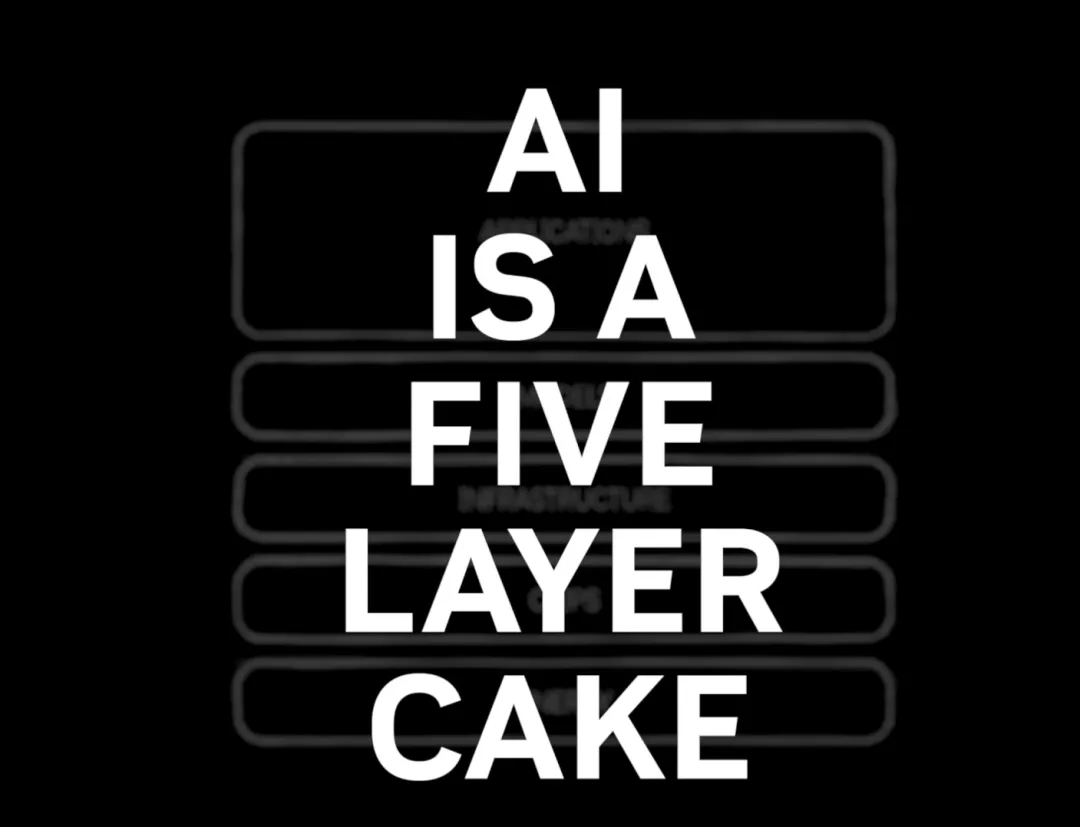
But what we’re actually seeing is AI destroying consumers’ livelihoods on a physical scale.
Overseas: At the end of March 2026, Oracle announced global layoffs of about 30,000 people—18% of its workforce—freeing up $8–10 billion in cash flow for AI data center construction. Legacy media BBC announced up to 2,000 layoffs in April, explicitly shifting resources toward AI-driven digital spaces. Days ago (May 2026), cybersecurity giant aka “cyber bodhisattva” Cloudflare also swung the axe, cutting 1,100 jobs (about 20% of staff), with its CEO stating the company’s AI usage surged 600% and employees run thousands of AI agent sessions daily—the company must shift to an “Agentic AI-first” operating model.
U.S. employment consulting firm Challenger, Gray & Christmas reported on May 7 that U.S. employers announced 83,387 job cuts in April, up 38% from March’s 60,620.
The report directly states:
In April, AI was the primary reason for layoffs for the second consecutive month, with 21,490 AI-related job cuts, accounting for 26% of total layoffs. Year-to-date, 49,135 people have been laid off due to AI, making it the third-largest cause of job cut plans. AI accounts for about 16% of all 2026 layoff plans, up from 13% in March.[1]
As for China? Let’s not go there.
Finance, media, tech/internet, gaming… these once high-paying industries are undergoing indiscriminate structural cleansing, layer by layer “passing the chill down.”
And the legal industry is no exception.
While productivity soars, the workers who should be paying for digital products are losing their income.
The public faces immense downward pressure on income expectations. Households’ precautionary savings motive remains high. The result: people are increasingly frugal with hard expenses like mortgages, rent, medical care, and food—with absolutely no disposable income or leisure to spend on the flood of AI products.
III. The “One-Person Company” as the New “Reservoir”
Where did all the knowledge workers spilling out of big tech and office towers end up? They naturally transformed into “one-person companies” (OPCs).
The media loves to package this phenomenon as a golden age of individual empowerment, assigning it tremendous emotional value.
One-person companies certainly have value, especially in an era of declining birth rates and rising labor costs. AI’s productivity boost is very real.
But from a macroeconomic perspective, within the current economic cycle, one-person companies are merely an enormous and hidden unemployment buffer during the economic downturn.
Deprived of corporate protection and stable compensation, these individual workers arm themselves to the teeth with AI tools. Using LLMs and open-source or self-built workflows, one person can simultaneously handle the roles of product manager, programmer, designer, and marketer.
They maintain extremely high-output intensity every day, wielding productivity that exceeds what an entire department once had. Some stable workflows even generate passive income while they sleep.
But how many actually succeed?
One of AI’s defining characteristics: it’s easy to replicate.
The birth of a stable workflow means within a short time, countless identical workflows will be replicated via AI, dumping endless AI products into the market every day.
Countless “one-person companies” form the ultimate reservoir for unemployed white-collar workers. They are precisely the main force of this service-sector productivity explosion. Yet they themselves, lacking risk resilience, tighten their wallets and refuse all non-essential consumption beyond tokens—until they hit the “lottery jackpot.”
IV. Platform Revenue-Sharing’s False Prosperity and the Drain on the Real Economy
Meanwhile, domestic AI content consumers don’t seem to actually pay for AI products either.
A seemingly “virtuous cycle” in the AI ecosystem: countless creators on free novel or short video platforms (like FanX, HongX, etc.) earn substantial revenue through platform ad revenue sharing, while readers don’t need to pay to unlock any chapters.
All they need to do is click the occasional ad.
AI-generated content has a place to go, consumers don’t pay subscription fees—everyone’s happy, everyone’s happy.
Of course, consumers aren’t directly paying. These revenues all come from advertising budgets diverted from the real economy. This money is essentially marketing expenses paid by real-world businesses.
When mass purchasing power declines, real-economy profit margins are already severely compressed, and overall social advertising budgets are shrinking dramatically. As the total pool of money shrinks while hundreds or thousands of times more AI content floods in to compete for a slice, per-unit revenue gets diluted infinitely.
While AI has improved ad production efficiency and enabled companies to cut costs through layoffs, the rising cost of ad conversion has nicely compensated for that.
Consumers tightening their wallets have long been affecting the real economy. Once the real economy faces profit declines leading to ad cuts or even bankruptcy waves, this virtual monetization model entirely dependent on traffic revenue-sharing collapses instantly.
Many in the restaurant industry around me have joined the contraction and closure trend.
Even “food, clothing, housing, and transportation” are tightening. How much time is left for everything else?
Come to think of it, the only winner seems to be that one platform?
Producers use that platform’s AI model to generate short videos, distribute them on that platform, and show them to that platform’s users.
Model call fees, creator revenue shares, creator buying traffic, merchant ad spending—all accounted for.
A truly “closed-loop AI business model.”
V. New-Era Subsistence Farming
Worse yet, AI’s deep penetration is destroying whatever commercial potential remains in the service sector. Faced with powerful and easily accessible tools, “consumers” are rapidly evolving into “producers.”
When Vibe Coding lowers the development barrier to the point where anyone who can speak can write code, everyone can achieve “self-production.” If an ordinary person needs a financial accounting tool, a specific data-cleaning script, or a bedtime story for their child, there’s no need to go to an app store and buy a paid service. Just open a coding agent, type a few needs, and within minutes you get a fully customized, free, dedicated tool.
The media frames this as representing how “AI is not just a productivity tool—it can also be ordinary people’s right to define their own lives”, where everyone can fulfill their own needs through AI.
But in essence, as Vibe Coding evolves, we have irreversibly entered the digital world’s “new-era subsistence farming economy.”
Everyone is self-sufficient in front of their own screens—coding for themselves, writing for themselves, reading for themselves—achieving complete “customization.” When the masses can easily acquire the means of production and satisfy their basic virtual needs, third-party tools and content on the market lose their buyers entirely.
Everyone is “reinventing the wheel” for themselves. No one pays for someone else’s “wheel.”
It’s clearly foreseeable that the entire market’s economic loop will completely fracture.
Companies use AI to increase efficiency tenfold, conveniently laying off 90% of their teams. The nine laid-off people are forced to form “one-person companies,” each using AI to write eight apps in a few days, trying to sell them to the one remaining employee. And that one person who kept their job is desperately saving money due to the constant threat of layoffs, even spending on tokens and premium model subscriptions to “keep their job,” with no surplus to support these external tools.
But why wouldn’t the remaining person just use company resources and their tokens to build a same-function app themselves?
VI. In Conclusion
Every technological carnival must eventually face scrutiny from underlying economic laws.
AI is absolutely the future—there is no doubt about it. AI will become as essential to everyone’s daily life as smartphones are today.
But until the physical world’s “great constraints” are broken, until real wealth distribution mechanisms see substantial improvement, or until society once again enters an economic upswing, ordinary consumers simply cannot gain real purchasing power or security from AI.
Under such a macro deadlock, dumping millions more app demos and tens of millions more AI-generated articles onto the internet every day achieves nothing except increasing data center power consumption, driving up storage device prices, causing flash memory shortages, and making it impossible for gamers to buy PCs.
It’s absolutely useless.
[1] May 07 Challenger Report: April Job Cuts Rise 38% from March; YTD Cuts Down 50%. https://www.challengergray.com/blog/challenger-report-april-job-cuts-rise-38-from-march-ytd-cuts-down-50