What Should Game Platforms Watch Out For? | On the 'Qinglang·Algorithm Typical Problem Governance' Special Action
China's Qinglang special action targets algorithm-driven problems on internet platforms; game platforms must break information cocoons, respect user choice, ensure transparency, and avoid misleading algorithmic practices.
With the rapid development of internet technology, algorithms have become the “moat” for platform operations.
Especially in the field of game operation platforms, the effectiveness of algorithms related to user profiling, personal interest tags, attention-grabbing materials (ICON, screenshots), algorithmic recommendations, and push mechanisms clearly represents a platform’s “hard power.”
However, with the release of the “Notice on Carrying Out the ‘Qinglang·Algorithm Typical Problem Governance’ Special Action” on November 24, some seemingly “efficient” and “powerful” algorithms and operational strategies may need to hit the brakes and first examine whether they are compliant.
Note: The term “platform” in this article refers to app store platforms or similar game operation platforms, i.e., applications and web services that provide game recommendations and download services.
This article represents only the author’s personal views and does not constitute legal advice or legal opinion.
I. Action Overview
The official action description is as follows:
Since the issuance of policy documents such as the “Guiding Opinions on Strengthening the Comprehensive Governance of Internet Information Service Algorithms” (hereinafter “Guiding Opinions”) and the “Regulations on the Administration of Algorithm Recommendations for Internet Information Services,” various departments and regions have strengthened organization and promotion. Website platforms have actively implemented relevant management requirements, and the algorithm application ecosystem has become increasingly standardized. However, some typical problems still require continuous governance.
To further deepen the comprehensive governance of internet information service algorithms, it is now decided to carry out the “Qinglang·Algorithm Typical Problem Governance” special action from now until February 14, 2025.
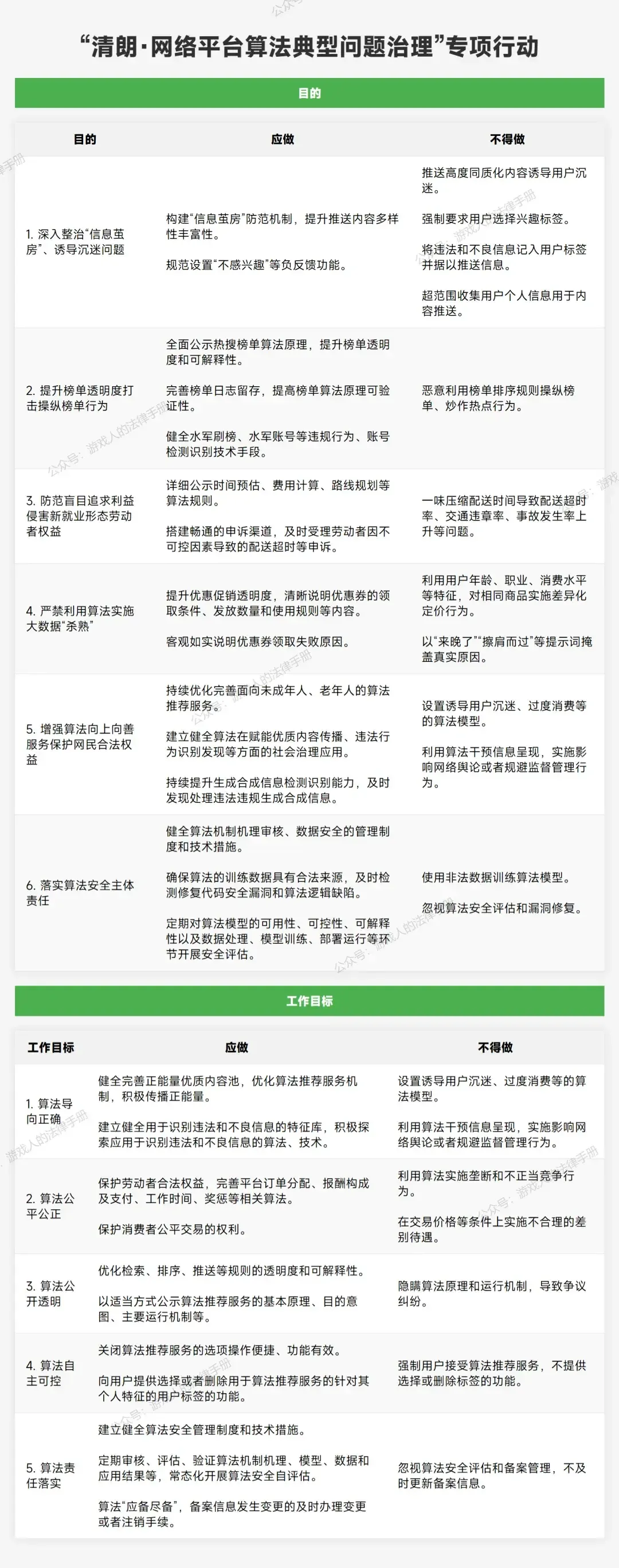
The “Notice” contains a lengthy list of “do’s” and “don’ts” written in a single paragraph, making it somewhat difficult to read.
I have organized them for everyone — just look at the image below:
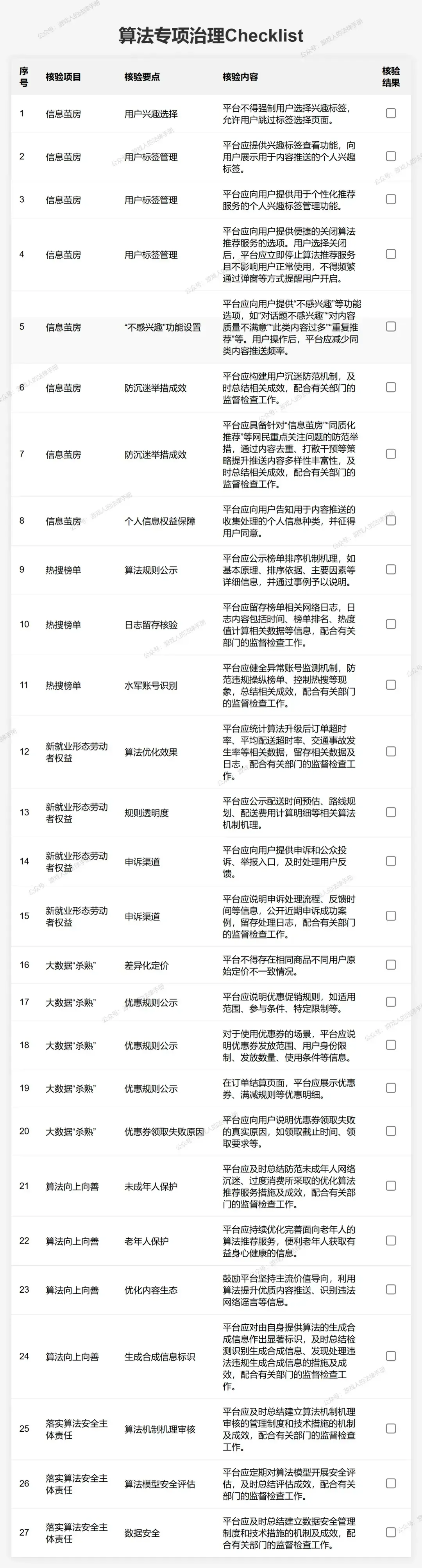
The “Notice” also includes an official guide, which I have also compiled into a checklist format:
II. What Should Game Platforms Pay Attention To?
The official guidance targets a wide range of platforms. Some content may not apply to game platforms (e.g., game companies providing work meals for employees do not face order timeout issues). Therefore, I have tailored the following list of “should do” and “must not do” items specifically for game platforms after the Notice’s issuance, for your reference and comparison:
Should Do
Break the “Information Cocoon,” Provide Diversified Content Services
Game platforms should allow users to easily find the games they want, while not only recommending similar games.
The recommendation system should not be based solely on download volume but should also consider multiple dimensions such as actual game quality and user feedback. Additionally, methods like “Editor’s Pick,” “Rising in Popularity,” and “New Products” can be used to recommend more diverse products.
Furthermore, when users register for the first time, they should not be forced to select their interests (e.g., not forced to choose what types of games they usually like to play), and recommendations should not be limited to interest-related games.
For example, when a user searches for a certain game category on the platform, it should not only display热门 products but also appropriately recommend some niche but quality games to help users discover more interesting content, breaking the “information cocoon.”
In the most compliant scenario, recommendation reason prompts are also needed.

Respect Players’ Right to Choose
Game platforms must fully protect players’ right to choose the platform’s algorithm services.
Game platforms need to develop convenient personalization settings, ensuring that users can easily browse the “tags” currently assigned to them and add or remove tags at any time according to their preferences to adjust recommended content. Whether changing interest tags or turning off specific types of push notifications, it should be simple, intuitive, and easy to operate. Especially regarding receiving pushes, ad placements, and even splash screen ads, users should have full autonomy to easily adjust or turn off the frequency and type of commercial推送.
That is, adjustment features should not be hidden within multi-level menus or small print.
Ensure Information Transparency
Game platforms must ensure the authenticity and transparency of information in content display.
For promotional content (such as sponsored articles, paid reviews, etc.), their commercial nature should be clearly identified with an “Ad” label. For games involving probabilistic mechanics, probability information should be clearly displayed. Game ratings and applicable age groups should also be clearly marked.
Key data such as download volumes and ratings must be authentic and可信, allowing users to make informed choices based on accurate information.
Platforms should also regularly publish the basic principles of their recommendation mechanisms, the ranking algorithms for each leaderboard, etc., to increase algorithm transparency.
Improve User Protection Policies, Especially for Minors
Platforms should establish a sound user rights protection system.
On one hand, they should provide convenient complaint and feedback channels, ensuring timely responses when users encounter problems. On the other hand, they must strictly implement personal information protection systems and strengthen data security management.
For minor users, they should design additional verification algorithms beyond real-name verification, strictly implement anti-addiction requirements, and ensure the effectiveness of protection measures.
Additionally, content review algorithms should be designed for public interactive areas such as comment sections and communities to automate monitoring and prevent the spread of inappropriate content.
Conduct Algorithm Filing
Platforms should establish a comprehensive algorithm filing system.
For algorithms currently in use that have a significant impact on users, platforms should, on their own or through professionals, file with the Internet Information Service Algorithm Filing System, striving to file as comprehensively as possible.
Must Not Do
Prohibition of Misleading Users
Platforms must not use algorithms to mislead user judgment under any circumstances.
This includes not fabricating download and rating data, not hiding important fee information, not artificially creating false game popularity, and not fabricating facts in review articles.
In search results, the line between genuine games and competing games that have purchased keywords must be clear. Platforms must not use algorithm design to confuse users.
Avoid Excessive Intervention
Algorithmic recommendations must not excessively interfere with user experience.
Platforms cannot force users to accept personalized recommendations, cannot frequently push messages that cause disturbance, and cannot restrict users’ ability to adjust the recommendation system. When a user explicitly refuses a certain type of content or turns off personalized pushing, the platform should respond immediately and must not continue pushing similar content or content based on user tags.
Prevent Data Misuse
In collecting and using user data, platforms must strictly adhere to the principle of necessity.
Game platforms must not excessively collect user information, must not use data collected for purposes not authorized by users, and must not arbitrarily share user profiles with third parties.
Additionally, platforms must not use user data to implement differentiated pricing strategies, such as coupons for paid games or充值 discount coupons.
Eliminate Inducement Practices
Platforms must not adopt any form of inducement algorithm strategies.
They cannot use psychological暗示 to stimulate user spending, cannot create false urgency for downloads, and cannot precisely target users’ psychological weaknesses.
For minors, algorithmic recommendations must be strictly controlled, and designs that may induce addiction must be resolutely avoided.
III. Conclusion
The above content does not cover all situations. Considering that each platform has its own unique features and operational strategies, this is for simple reference only. Actual analysis should be conducted professionally based on the platform’s own circumstances.
However, simply put, game platforms should always prioritize user experience, providing a safe, transparent, and controllable environment for game discovery through完善的 algorithm management mechanisms, jointly fostering a healthy industry ecosystem.
Only by truly balancing the interests of all parties can the healthy development of the entire gaming industry be promoted.