Brief Commentary: Unity to Charge by 'Install Count' Starting Next Year | Is the Ultimate Business Warfare to Flood a Rival with 100 Million Installs?
Examines the legality of Unity's 2024 per-install fee model, analyzing why unilateral pricing changes are likely legal under subscription contracts, the criminal risks of using workarounds to avoid fees, and the unfair competition liability for inflating a rival's install counts.
On the evening of September 12, Beijing time, renowned game engine company Unity announced on its official website that starting January 1, 2024, it would implement a new “per-install” fee model for qualifying game products. The specific fee rates will vary based on the Unity version used or purchased by the developer, the user’s market region, and will follow a tiered fee structure.
The announcement caused an uproar in the domestic and international gaming industry. Based on Unity’s initial policy, developers feared that Unity would not exclude any form of repeated installation (single-platform or multi-platform), pirated games, or installations that generate no revenue (such as limited-time free or limited-time test versions), among other types of repeated or improper installations, leading to substantial additional costs.
Some even joked, “Let’s give our competitors 100 million installs next year.”
Amidst the widespread outcry, Unity urgently released an official FAQ document addressing some common concerns, but it still failed to quell the anger of developers.
So here are the key questions:
Is Unity’s unilateral addition of a new fee point legal?
Does inflating a competitor’s install counts constitute infringement?
Is it permissible to use “workarounds” to avoid Unity’s “arbitrary fees”?
一、What is Unity?
Although many readers may already know, it’s worth introducing as usual:
Unity is a cross-platform 2D and 3D game engine developed by Unity Technologies, with its first version released in 2005. Unity can be used to develop cross-platform video games, mobile games, HTML5 web games, VR games, and more.
Many well-known games at home and abroad are developed using Unity, such as Apex Legends, Cities: Skylines, Hearthstone, Among Us, and the very familiar Honor of Kings and Genshin Impact (though they use heavily customized versions).
In China, Unity has become the primary — even the only — engine considered by developers when creating 3D mobile games. The vast majority of domestic mobile 3D games are built on the Unity engine, giving it an “unrivaled” presence.
Therefore, the Chinese mobile gaming market is “bearing the brunt” of this fee change.
二、Unity’s Specific Fee Change Plan
On the day Unity announced its fee plan, discussions were rampant online. Amid the questioning, Unity later released more detailed explanatory text.
Thus, the author waited until the dust had temporarily settled before writing this article.
Not because of procrastination.
Here is a summary of the reform plan:
1. Fee Model:
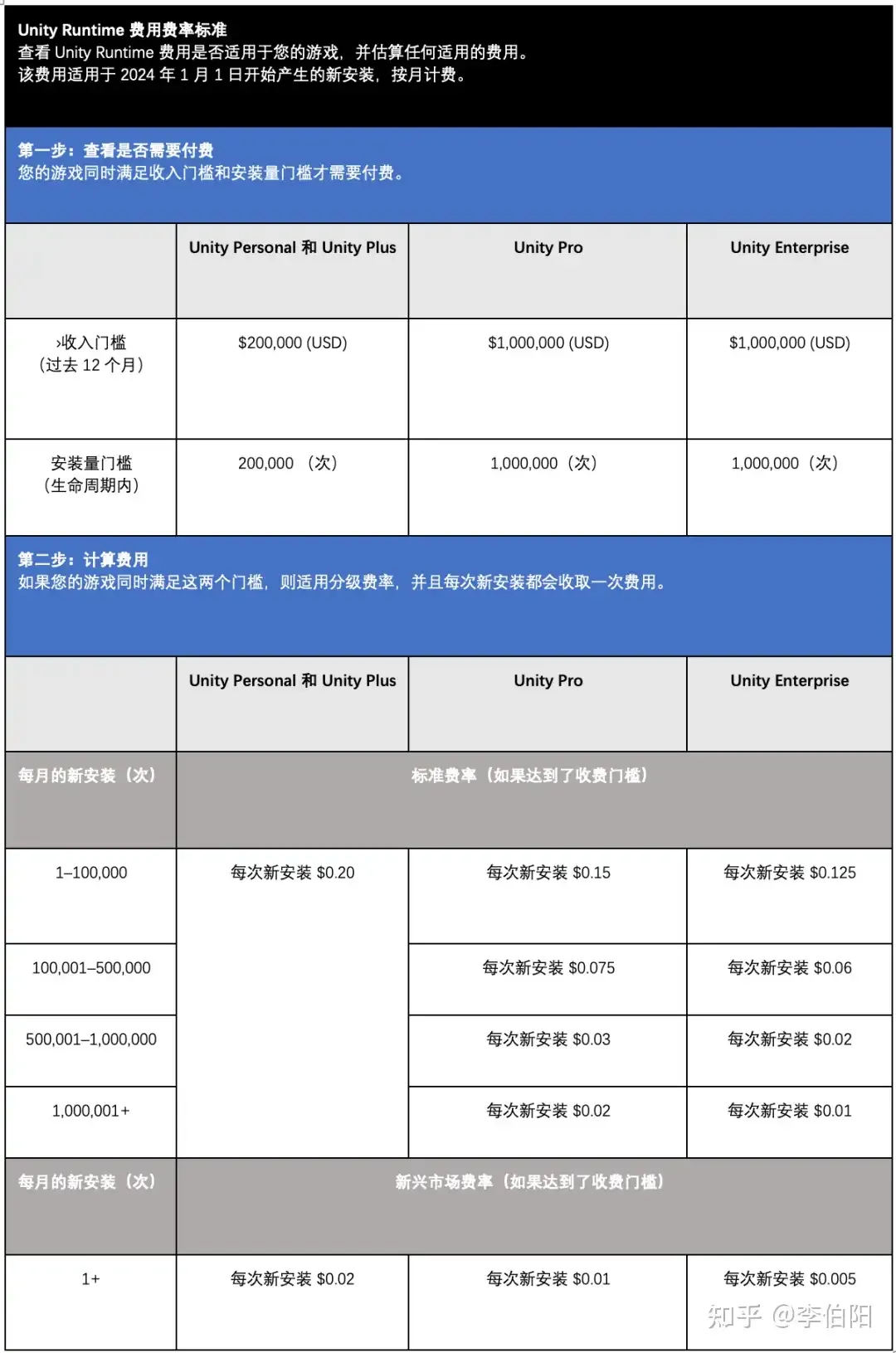
This is the table provided by Unity. As shown, the versions subject to this fee cover all tiers from Personal to Enterprise, meaning that as long as a game is made with the Unity engine and reaches the revenue threshold, it will be subject to an installation fee.
Standard rates apply to app installations in the US, Australia, Austria, Belgium, Canada, Denmark, Finland, France, Germany, Ireland, Japan, Netherlands, New Zealand, Norway, Sweden, Switzerland, South Korea, and the UK. Emerging market rates apply to all other countries/regions.
Therefore, China is classified as an emerging market, with fees ranging from $0.005 to $0.01 per new installation.
Additional note:
The original Unity table was somewhat unclear, causing discussion. The term “monthly rate” in the table actually means that fees are calculated and paid on a monthly basis (a one-time charge), not that the same installs are billed repeatedly each month.
Regardless of the version, the revenue threshold is calculated independently based on the previous 12 months’ revenue, not on a “cumulative lifetime” or “once threshold is met, payment is assumed.”
This means that if revenue fluctuates over the previous 12 months (e.g., an event in August last year generated high revenue, but revenue dropped the following month), you might pay the install fee when calculating the 12-month period from August this year, but when recalculating in September, you might not meet the threshold and thus not need to pay.
2. When Does Billing Start?
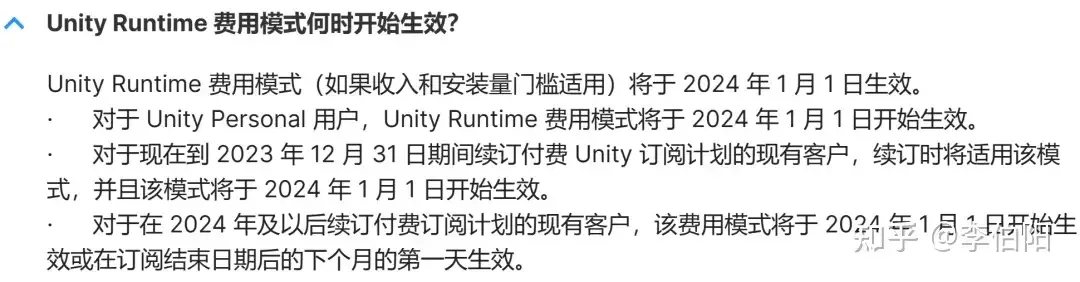
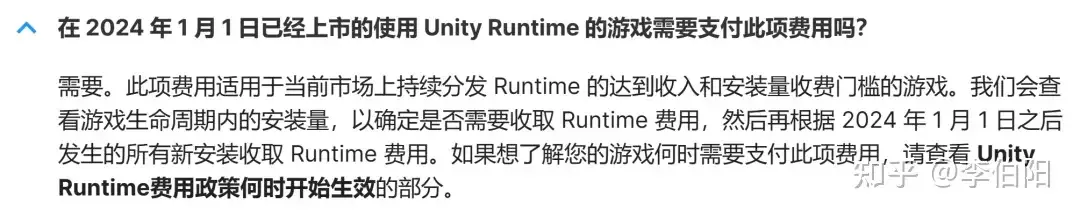
Regardless of when a game was released, billing will start next year.
However, for Pro/Enterprise users who paid or renewed before September 12 this year, billing can be delayed until the next renewal date at the latest.
This also implies that Unity will change its user agreement (contract) upon renewal.

Installs occurring before January 1, 2024, will not be billed, and there is no need to pay for previous installs (existing major game titles breathe a sigh of relief). These previous installs will only be used for threshold calculation.
3. How Is the Install Count Calculated?
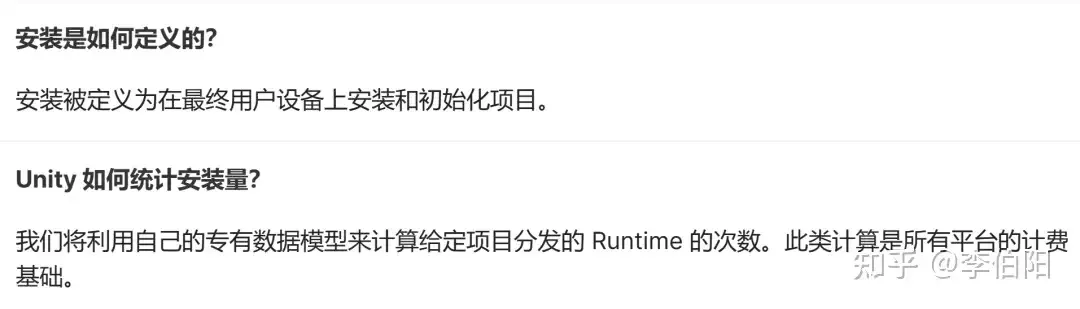


According to the official statement, Unity will self-calculate install counts through a completely “black box” method. Its vague wording on the issue of “actively contacting the server” suggests that the current calculation method may be:
(At least from the 2022 version onward) Unity Runtime will communicate with Unity’s server and send an “install” notification every time a game is installed. Unity may also aggregate statistics on download/installation counts displayed across various channels.
Considering the official statement that it will not violate GDPR or CPPA, and that repeated installs on the same device will not be billed, it can be inferred that the data sent by Runtime will include the device’s identification code but will not include identity information such as IP address.
A simple identification code cannot easily identify or link to a specific user, so prior user consent may not be required.
The above is merely the author’s speculation; the actual situation may differ. Please refer to Unity’s specific implementation.
However, the author also suggests:
Do not inflate download figures too much in future ad campaigns or landing pages.
This may not only constitute false advertising
but may also be used by Unity as evidence to demand install fees.
4. Repeated Installs
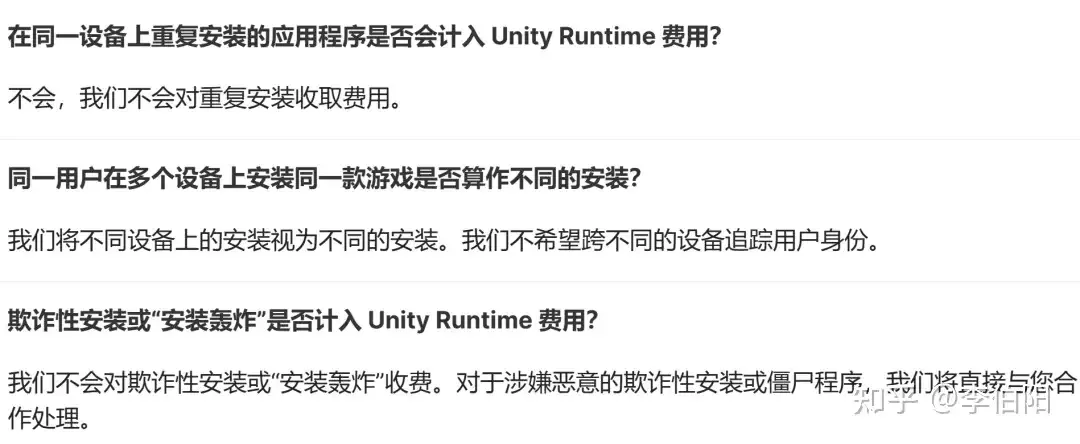
Based on our inference above, Unity will only charge based on the machine identification code, which is why repeated installs across different devices will also be billed.
Although Unity officially states that it will not charge for fraudulent installations or “install bombing,” the response is only “cooperative handling,” meaning developers may need to provide their own evidence.
Domestic mobile device manufacturers, such as Xiaomi, offer a blank pass feature. Whether this would cause Unity to treat them as “different device” installs requires further clarification from Unity.
Considering that it is not difficult to modify the machine identification code of an emulator, how to identify such “install inflation” behavior without violating privacy laws will be a headache for developers in the future.
Note: IP addresses are personal privacy. Developers must not proactively collect them before the user agrees to the privacy agreement. Using IP addresses for identification may violate the law.
5. Other Exempt Installations


The detailed explanation essentially responds to the objections raised online:
Demos, QA, pirated copies, web versions (good news for H5 games), streaming (good news for cloud gaming), and charity bundles are exempt. However, note:
Demos must not contain the full game content, so Early Access (EA) and paid-unlock versions will be subject to install fees.
The solution for pirated copies is also “cooperative handling,” so developers will need to consider how to prove they have been harmed by piracy.
Additionally, the explanation regarding subscription-based services states that “developers do not distribute these games,” so “developers do not need to pay.” However, combined with:
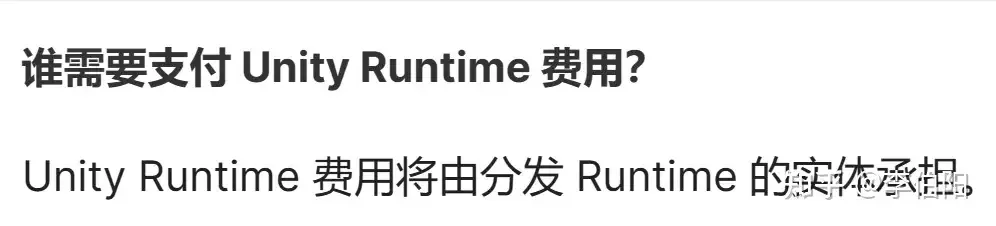
This also means that in subscription-based scenarios, Unity may charge the subscription platform.
This cost may eventually be passed back to the developer.
Under this fee policy, considering that domestic companies are often not integrated developer-publishers, Unity may not charge the developer directly, but rather the publisher (who distributes the Runtime).
三、Is Unity’s Sudden Fee Legal?
Many in the industry may wonder:
“I used Unity to develop a game, and now it suddenly wants to charge me. I either pay or switch engines. Is this high-handed behavior legal?”
Unfortunately, under the current legal framework, it may well be legal.
Unity is a Subscription-Based Software
Unity switched to a subscription model many years ago and no longer offers or sells perpetual licenses for any specific version.
While Unity does offer deeply customized versions of certain releases (providing source code and support to help game companies customize their own modified engines), due to cost considerations, the vast majority of small and medium-sized enterprises use the subscription model.
In other words, game companies only obtain a limited-term right to use the Unity engine, not ownership.
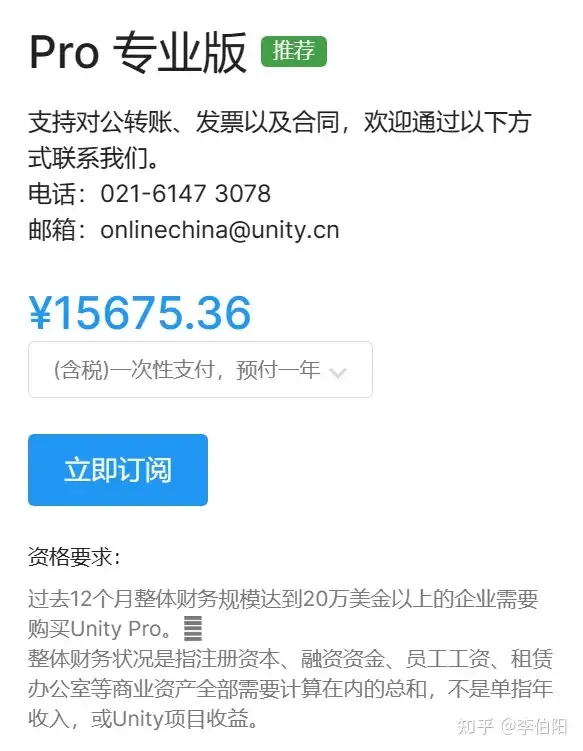
Currently, legitimate Unity software requires logging into a Unity account via Unity Hub to launch, with access rights determined by the subscription version.

Once the service or subscription is terminated, Unity has the right to immediately stop the game company’s access to and use of Unity software, preventing them from opening their source programs through Unity (excluding the use of pirated/cracked software).
Therefore, from the very first day a game company uses/signs up for Unity, they should understand that they must continue to pay for Unity usage, and that failure to pay will prevent them from maintaining their Unity projects.
Whether a game company is dissatisfied with Unity’s new fee policy due to subscription price increases (Unity has raised prices multiple times historically) or the addition of new fee points, and chooses not to renew, they should equally accept the consequences of subscription termination (inability to continue maintaining the project).
Unity is Not Unilaterally Changing the Contract During the Subscription Term
As we can see above, Unity’s new fee policy takes effect upon renewal for PRO and Enterprise editions.

Personal edition users, being free users, are deemed to have “accepted the new policy by using the software.”
For PRO and Enterprise customers, the new policy only activates after renewal. This means Unity is not “unilaterally changing the contract during the contract term” but rather “announcing new contract terms in advance.” Therefore, it is not subject to Article 543 of the Civil Code, which states: “Parties may modify a contract upon consensus.”
After all, upon renewal, it is a new contract.
Any terms Unity proposes for the next contract period are at its discretion as a service provider. Therefore, no matter how outrageous the new fee model is, as long as it does not affect the performance of the existing contract, Unity is not in breach.
Unity Is Not a “Necessity” for Games, Nor Does It Constitute a Monopoly
Another popular argument is:
“A bunch of games rely on Unity. Unity charging like this is using its monopoly position to force everyone to pay or pay high costs to switch engines. This is unfair.”
Unfortunately, when you can say “switch engines,”
it directly shows that Unity is not a “necessity” for a game,
nor does it constitute a “monopoly.”
According to the Anti-Monopoly Law, to find that a company holds a monopoly (market dominance) position, the following criteria must be met:
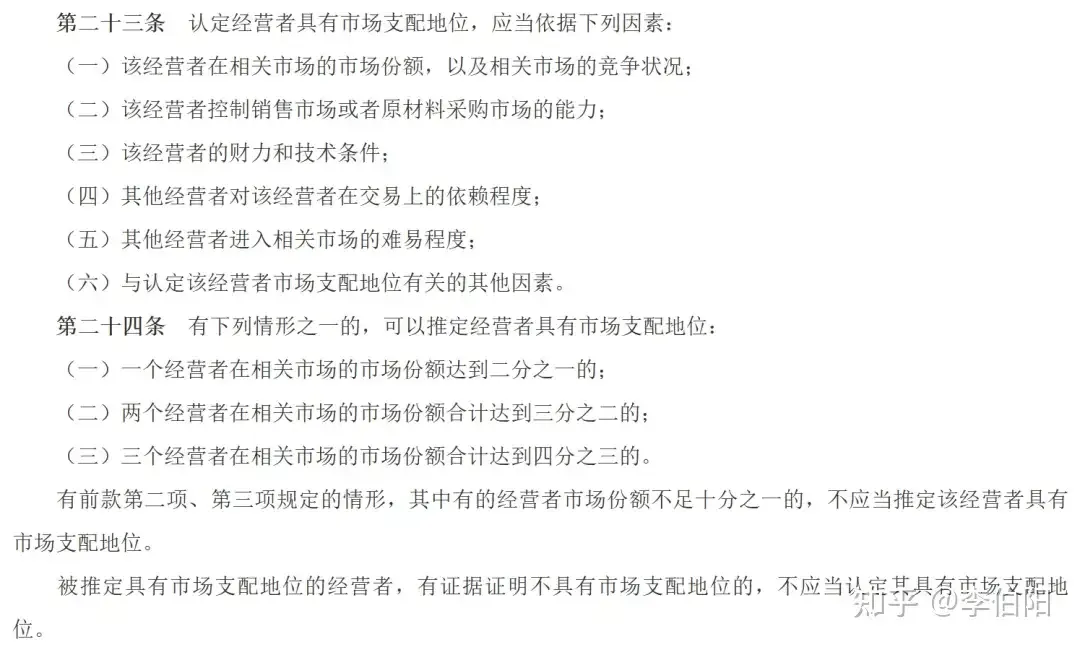
It would be difficult to argue that Unity accounts for “half the market” in the cross-platform game engine space.
Even narrowing it down to the mobile platform, in the domestic gaming industry alone, games made with engines such as Cocos, Unreal, and Laya are not uncommon. Proving that Unity constitutes a “monopoly” is no easy task.
Moreover, a game cannot only be made with Unity. With two different engines, capable developers can create very similar games (80-90% similarity).
This means that Unity is not “irreplaceable.”
When Unity changes its fee structure, game companies can completely reject the new contract by opting for an “alternative engine.”
While switching engines incurs remastering costs, changing product suppliers (as in the restaurant or manufacturing industries) inherently leads to increased costs. Therefore, it is difficult to argue solely on this basis that Unity is using its industry position to harm existing customers’ interests.
In summary, although Unity’s new policy appears highly “unethical” within the industry, it is hard to say that Unity has violated any laws or regulations in practice.
That is why overseas developers have largely responded with “condemnation,” “boycotts,” and “public declarations of switching engines,” rather than filing lawsuits.
四、What Legal Liability Arises from Using Workarounds to Avoid Unity’s Fees?
In response to Unity’s new fee model, netizens have come up with various ingenious “countermeasures,” such as:
Using old cracked versions of the software to package games;
Restricting Unity Runtime from accessing the internet;
Forging device identification codes;
And so on.
If these actions are actually implemented,
Unity may not have violated the law,
but the game developer would.
Let’s briefly discuss the above options:
1. Using Old Cracked Versions:
Unity provides downloads of all versions on its official website.
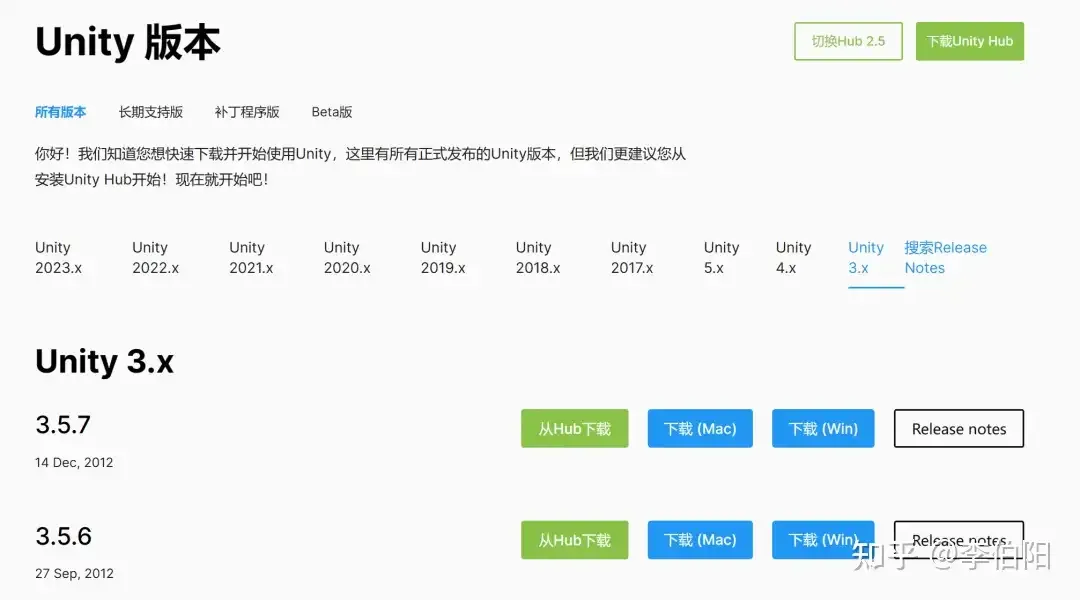
The Runtime module of games packaged with old versions of Unity may indeed not include the install counting feature — provided the project is compatible and the Unity software has not downloaded online updates.
Therefore, to avoid updating the Runtime by not logging into a Unity account, disabling updates, or using it offline, the only remaining path is to use cracked versions.
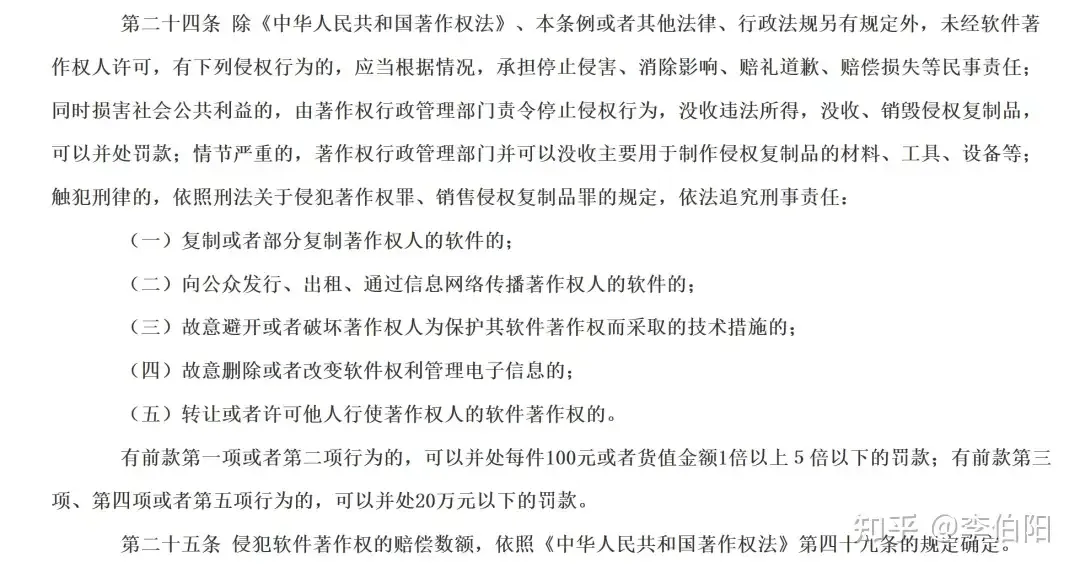
However, using cracked versions constitutes infringement of Unity Technologies’ copyright.
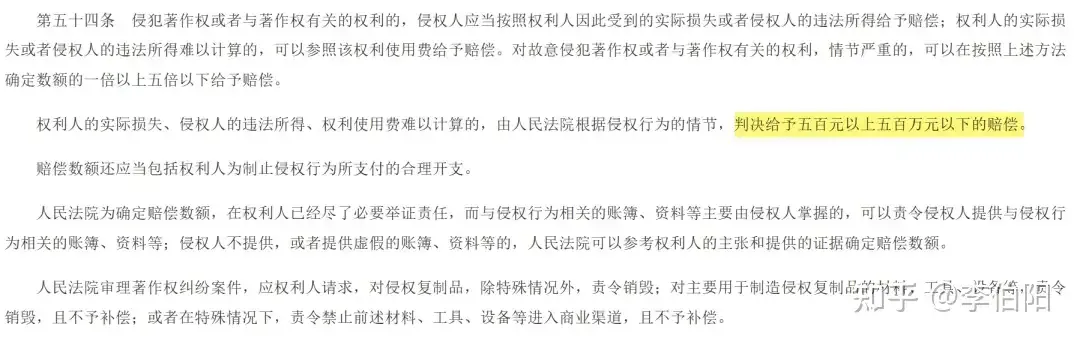
According to the Regulations on the Protection of Computer Software, using pirated software (excluding the act of creating cracking tools) may constitute “intentionally circumventing or destroying technical measures taken by the copyright owner to protect their software copyright.” In addition to a fine of up to 200,000 yuan, under Article 54 of the Copyright Law, compensation of up to 5 million yuan may also be required.
2. Restricting Unity Runtime’s Internet Access (Interfering with Telemetry Transmission) or Forging Device Identification Codes
Solutions proposed by Zhihu netizens (the author does not recommend them and has therefore blurred them):
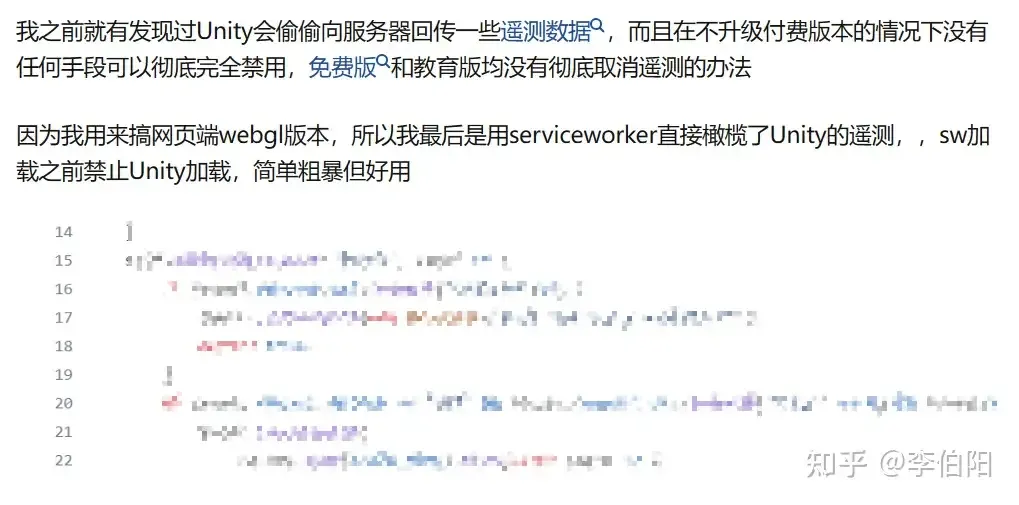
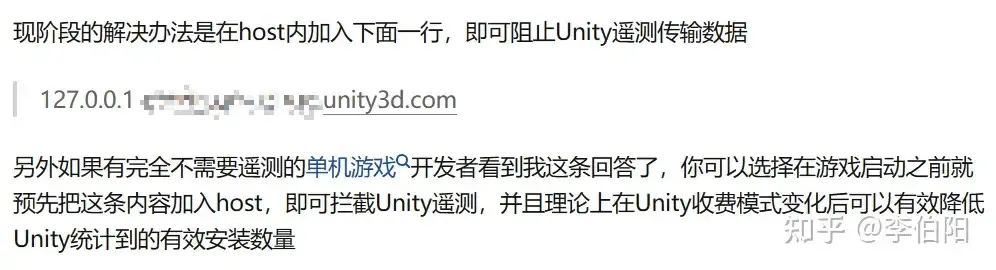
Whether through the serviceworker scheme, the host scheme, or sending forged device identification codes, the essence is to prevent Unity Runtime from sending statistical information to Unity’s servers, making it impossible for Unity to accurately count installations, thereby reducing fees.
At the mild end, this constitutes a breach of contract; at the severe end, it could be the crime of destroying computer information systems.
We all understand breach of contract, so no further explanation is needed.
Let’s focus on the crime of destroying computer information systems.
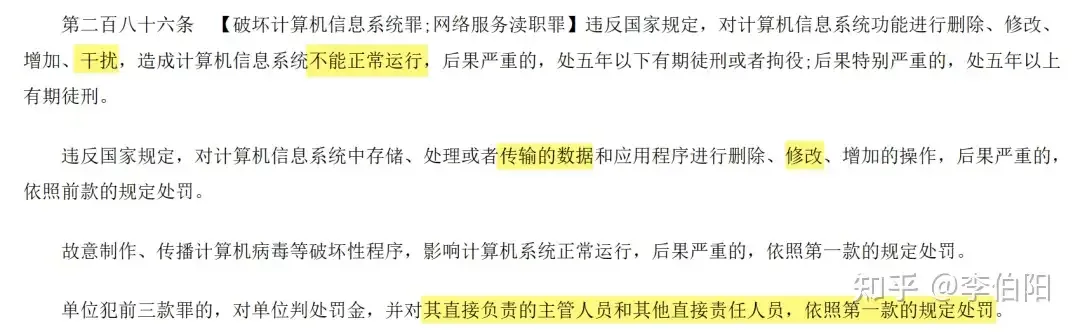
According to Article 286 of the Criminal Law, interfering with a computer information system, causing it to fail to operate normally, or modifying data transmitted by a computer information system, may constitute the crime of destroying computer information systems.
Preventing Unity Runtime from correctly collecting data clearly constitutes either interfering with operations or modifying data.
If convicted, supervisory personnel and other directly responsible persons may face fixed-term imprisonment of up to five years or more.
The threshold for sentencing is also lower than many people think:
Interpretation of the Supreme People’s Court and the Supreme People’s Procuratorate on Several Issues Concerning the Application of Law in the Trial of Criminal Cases Involving the Destruction of Computer Information System Security, Article 4
| Scenario | Conditions for “Serious Consequences” | Conditions for “Especially Serious Consequences” |
|---|---|---|
| Causing software or hardware to fail to operate normally | Major software or hardware of 10+ computer information systems fails to operate normally | Major software or hardware of 50+ computer information systems fails to operate normally |
| Deleting, modifying, or adding data | Deleting, modifying, or adding data stored, processed, or transmitted in 20+ computer information systems | Deleting, modifying, or adding data stored, processed, or transmitted in 100+ computer information systems |
| Economic loss | Illegal gains of 5,000+ yuan or economic loss of 10,000+ yuan | Illegal gains of 25,000+ yuan or economic loss of 50,000+ yuan |
| Basic services failing to operate normally | Causing basic services such as domain name resolution, identity authentication, or billing for 100+ computer information systems, or services for 10,000+ users, to fail to operate normally for a cumulative 1+ hour | Causing basic services such as domain name resolution, identity authentication, or billing for 500+ computer information systems, or services for 50,000+ users, to fail to operate normally for a cumulative 1+ hour |
| Other serious consequences | Other serious consequences | Destroying the functions, data, or applications of computer information systems providing public services in areas such as state organs, finance, telecommunications, transportation, education, medical care, or energy, resulting in severe impact on production, daily life, or creating adverse social impact |
Many people think only desktop systems like Windows or macOS qualify as “information systems.”
However, in current case law, mobile games have already been recognized as “computer information systems.” People who have made game cheats have been convicted under this crime:
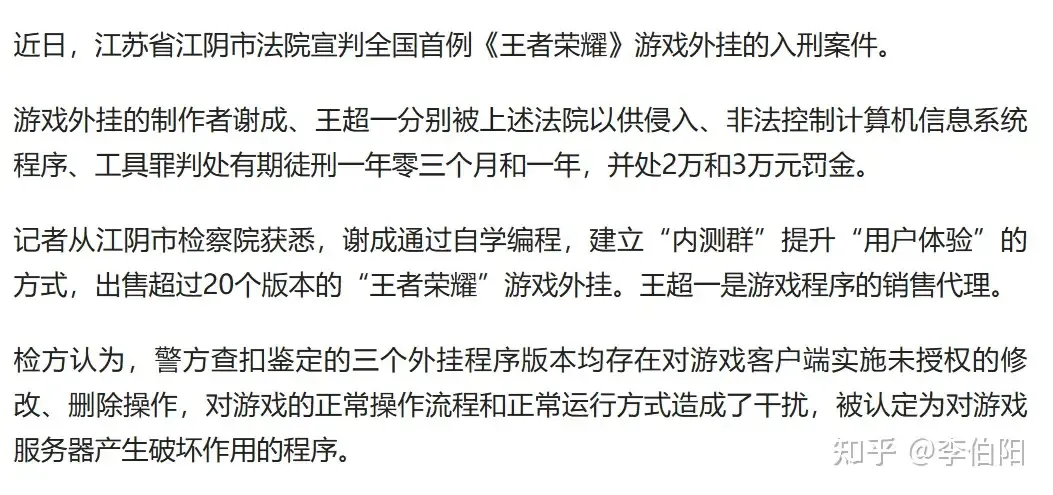
Thus, Unity is naturally also part of a “computer information system,” and interfering with its operation may similarly constitute this crime, with corresponding criminal consequences.
五、What Legal Liability Arises from Inflating a Competitor’s Install Count?
On the day Unity announced its new plan, this joke was circulating in many industry groups:
The most “sophisticated” business warfare often requires only the simplest methods —
For example, giving a competitor’s game 100 million installs.
Assuming Unity cannot identify the inflated installs, based on Unity’s official pricing:
100 million installs = 100,000,000 x $0.01 = $1,000,000 = ¥7,295,900
The installs are generated this month; the company is gone the next.
However, once investigated,
this would be a clear act of unfair competition.
Nowhere to run.
At first glance, giving someone else installs doesn’t seem to fit any specific unfair competition act listed in Chapter 2 of the Anti-Unfair Competition Law.
But Article 2 serves as a catch-all:
Article 2: In their production and business operations, business operators shall adhere to the principles of voluntariness, equality, fairness, and good faith, and comply with laws and business ethics. “Unfair competition acts” as referred to in this Law refer to acts by business operators that, in their production and business operations, violate the provisions of this Law, disrupt the order of market competition, and harm the lawful rights and interests of other business operators or consumers. “Business operators” as referred to in this Law refer to natural persons, legal persons, and unincorporated organizations engaged in the production or sale of goods or the provision of services (hereinafter, goods include services).
Generating installs for a competitor to maliciously increase their costs should constitute a violation of the principles of fairness, good faith, and business ethics, disrupting market competition and harming the competitor’s lawful rights and interests.
Furthermore, although Article 2 of the Anti-Unfair Competition Law does not stipulate criminal liability and there is no very clear criminal provision targeting such behavior,
the author believes that such conduct may also meet the elements of the crime of disrupting production and operations. Although this crime on its face seems more focused on agricultural or industrial production equipment, unlike the “crime of intentional destruction of property,”
the purpose of the “crime of disrupting production and operations” is to affect the normal conduct of the victim’s daily operations.
Article 276: [Crime of Disrupting Production and Operations] Anyone who, out of revenge or other personal motives, destroys machinery and equipment, cruelly injures draft animals, or otherwise disrupts production and operations by other means, shall be sentenced to up to three years of fixed-term imprisonment, criminal detention, or public surveillance; if the circumstances are serious, the sentence shall be between three and seven years of fixed-term imprisonment.
The act of inflating installs is clearly intended to disrupt a competitor’s normal production and operational environment by increasing their unreasonable expenses, thereby reducing competition.
However, since this is not the core focus of this article, we will not delve into it further.
六、Feasible Alternatives
Since Unity is being so aggressive, and companies will face additional costs next year, is there a quick way to replace Unity?
There actually is.
Unreal Engine?
Although Unreal is also a mainstream engine, it uses a different programming language, making a quick switch difficult — replacing it before January 1st next year is no easy task. Besides, it also takes a revenue share.

Godot is a versatile, cross-platform 2D/3D open-source game engine. It runs on Windows, macOS, Linux, and other operating systems. Games created with it can run on PC, Android, iOS, HTML5, and other platforms.
Official project URL: https://github.com/godotengine/godot
It can also be downloaded on Steam (yes, you read that right).
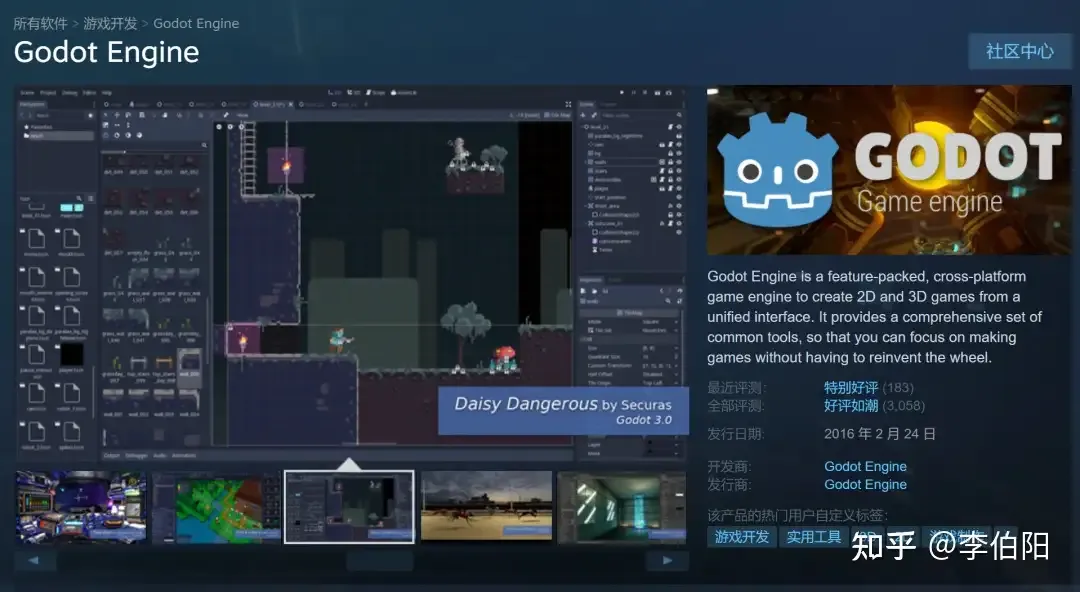
Godot is fully free and open-source under the MIT license and is supported by the Software Freedom Conservancy. Games made with it — even every line of engine code you modify yourself — belong entirely to you.
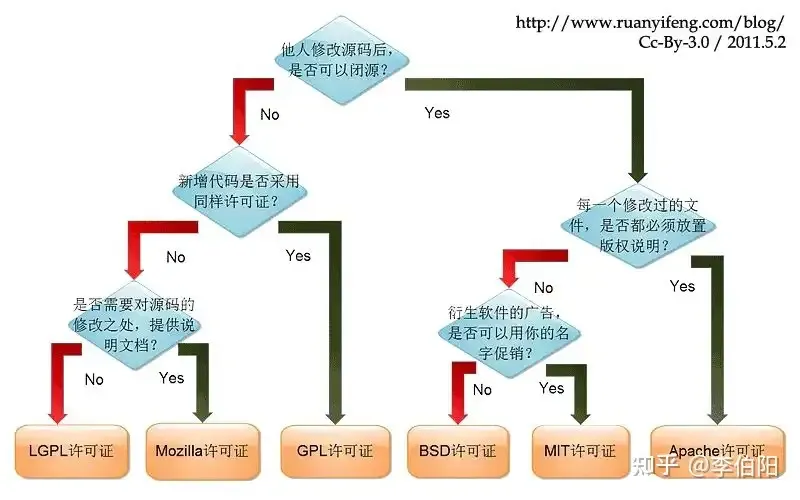
Using a diagram from Ruan Yifeng to roughly illustrate what the MIT license means.
Games made with Godot can be closed-source, do not need to include a copyright notice, and can be attributed in your own name — the most free and permissive open-source license.
For notes on using open-source code, see also:
Godot supports game development using different programming languages, such as Godot’s own GDScript (similar to Python), C++, and C#, which is consistent with Unity.
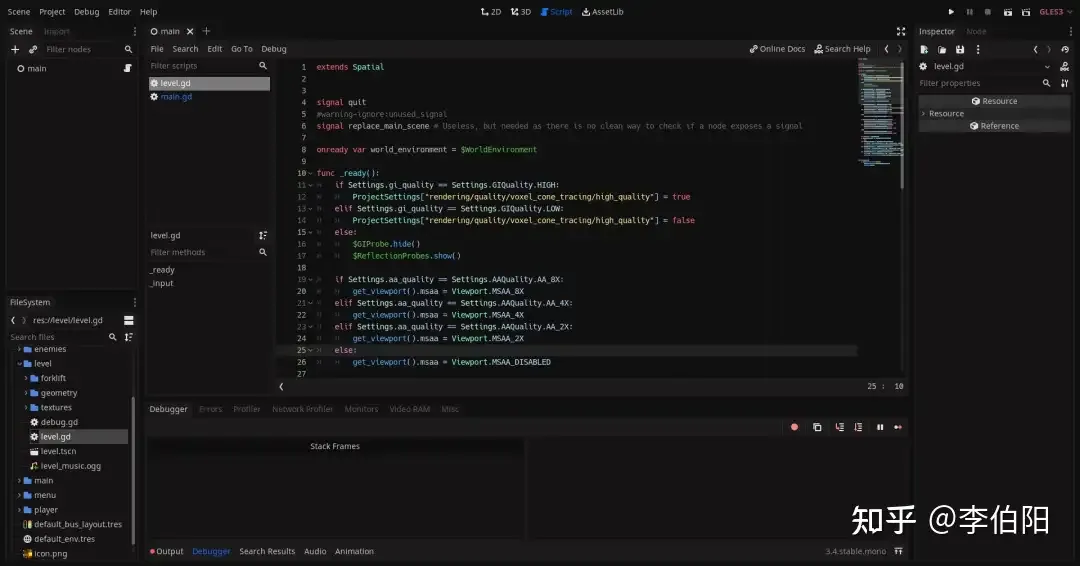
Similarly, it supports importing model resources from 3DsMAX/Maya/Blender.
In terms of UI, it is also very similar to Unity.
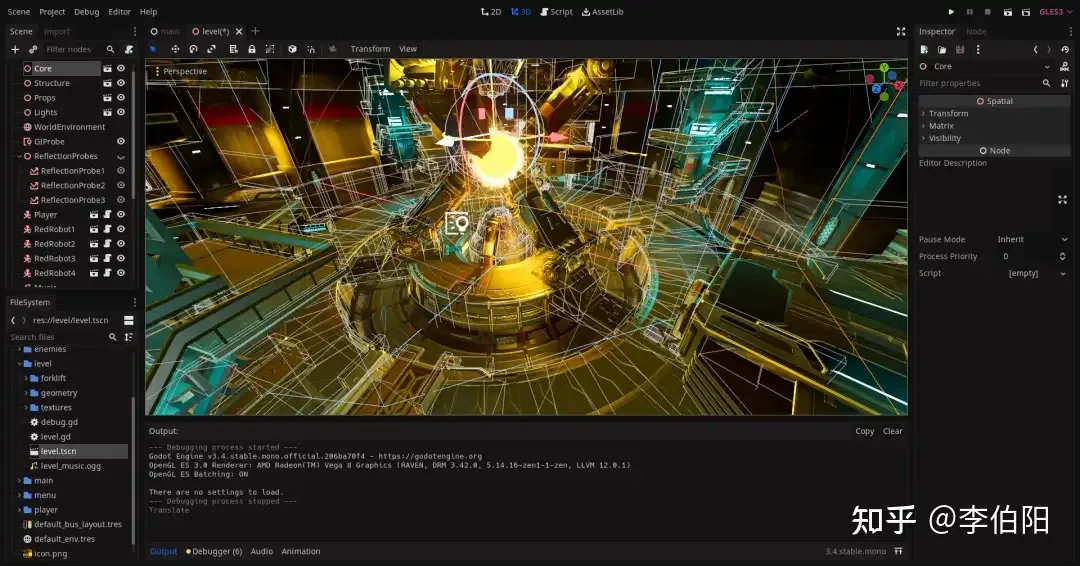
Of course, compared to Unity, it cannot compete in terms of maturity, but the advantage is that it is completely free and completely open-source. You will never have to pay for engine usage, negotiate with Unity salespeople, or bear the risk of infringement from cost-cutting measures.
This article is not a promotion of Godot.
The author personally has a strong preference for open-source software.
For example, for 3D modeling, the author also recommends using Blender instead of 3DsMAX,
thereby reducing the risks associated with improper use of commercial software.
七、Conclusion
Unity announced again today (September 18) that it will continue internal discussions on the new plan. Considering that its stock price has been declining since the announcement, whether the plan will actually be implemented next year remains uncertain.
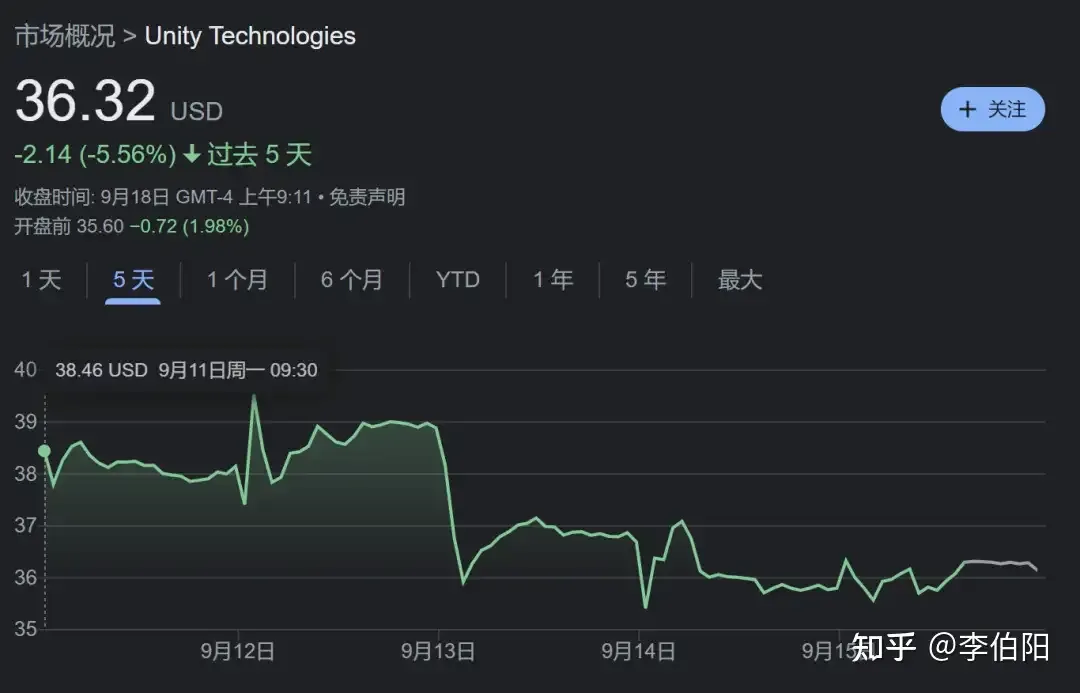
However, through this article, we can at least understand:
Price increases are not illegal.
Inflating installs is absolutely illegal.
After all, most of the easy money-making methods people think of are already written in the Criminal Law.
Rather than coming up with bad ideas,
it’s better to put more energy into game development.