Regarding Cross-Regional Law Enforcement ('Cross-Province'), What Game Industry Professionals May Want to Know About Relevant Legal Knowledge
An overview of cross-provincial criminal case handling in China's gaming industry, covering summons, detention, arrest procedures, and company property risks.
Foreword
In the past two years, bosses and key employees of major game companies
May have increasingly heard a term
“Cross-Province”
Company bosses and employees being “rounded up” and taken to other provinces
This scene that seems to only appear in TV dramas
Is quietly happening within the industry and is showing signs of spreading.
As the saying goes, “know yourself and know your enemy, and you can sleep early.”
What is “cross-province”?
What are the relevant legal provisions for “cross-province”?
Let us
Explore together.
This article represents only the author’s personal views and should not be considered legal advice or opinion.
I. What is “Cross-Province”?
The standard name for “cross-province” should be “cross-regional case handling,” which is one of the statutory procedures for跨-regional investigation and handling of criminal cases.
Cross-regional case handling usually arises from the need for criminal case investigation and handling. When the public security authority with jurisdiction over a criminal case is in a different location from the suspect, the public security authority with jurisdiction, after completing certain procedures, goes to the suspect’s location to conduct investigations and execute relevant law enforcement actions.
Criminal cases are generally under the jurisdiction of the public security authority at the location of the crime. For specific criminal acts in the internet industry where game companies operate, there are special provisions:
Article 17: For crimes committed against or primarily using computer networks, the public security authorities at the location of the server used for the network service for committing the crime, the location of the network service provider, the location of the infringed network information system and its管理者, as well as the location of the network information system used by the suspect or victim during the crime, the location of the victim at the time of infringement, and the location of the victim’s property loss have jurisdiction.
Provisions of the Ministry of Public Security on the Procedures for Handling Criminal Cases by Public Security Authorities (2020)
The “Provisions” specify that the public security authority at the location of the infringed party has jurisdiction. Considering the borderless nature of network services, this means that once a case is reported and deemed to involve a criminal offense,
It can be cross-jurisdictional nationwide.
A public security authority in any location can, after completing certain procedures, handle cases in other jurisdictions.
II. What Law Enforcement Activities Can Be Conducted During Cross-Regional Case Handling?
During cross-regional case handling, as long as the procedures are complete, the vast majority of law enforcement activities can be conducted.
Article 346: When public security authorities execute summons, forcible summons, detention, arrest, or conduct investigative activities such as inspection, examination, search, seizure, freezing, and interrogation in other jurisdictions, they shall submit a request for case handling cooperation to the local public security authority and proceed with the assistance of the local public security authority, or entrust the local public security authority to execute on their behalf.
For investigative activities such as inquiries, interviews, identifications, or serving legal documents, a request for case handling cooperation may also be submitted to the local public security authority, and notification shall be made in accordance with relevant regulations.
Here is a brief explanation of the meanings of summons, forcible summons, detention, and arrest:
Summons
Summons refers to the act of a public security authority, procuratorial authority, or court, through oral or written notice, requiring a suspect, defendant, witness, or other party related to a case to voluntarily appear at a designated location at a specified time to cooperate with investigations, undergo questioning, or provide testimony.
Summons is not a compulsory measure and is not mandatory.
The duration of summons and forcible summons shall not exceed twelve hours; if the case is particularly重大 or complex and requires detention or arrest, the duration of summons and forcible summons shall not exceed twenty-four hours.
Article 117: Suspects who do not need to be arrested or detained may be summoned to a designated location within the city or county where the suspect is located or to their residence for questioning, but a certificate from the people’s procuratorate or public security authority must be presented. For suspects found at the scene, after presenting identification, oral summons may be used, but this must be noted in the interrogation record.
The duration of summons and forcible summons shall not exceed twelve hours; if the case is particularly重大 or complex and requires detention or arrest, the duration of summons and forcible summons shall not exceed twenty-four hours.
Continuous summons or forcible summons shall not be used as a disguised form of detention of the suspect. When summoning or forcibly summoning a suspect, the suspect’s eating and necessary rest time must be ensured.
Criminal Procedure Law
Forcible Summons
Forcible summons is a compulsory measure.
If the case circumstances are特殊, or if a suspect who has been summoned fails to appear without正当 reason, the public security authority may forcibly summon them to the public security authority’s law enforcement office in the city or county where they are located for questioning.
In simple terms, the police personally take them back for questioning.
It is worth noting that forcible summons is not a prerequisite procedure for summons; that is, the public security authority may also directly execute forcible summons without prior summons.
The specific time limits are mentioned in the summons provisions, also 12/24 hours.
When executing summons or forcible summons in another jurisdiction, the suspect will first be summoned or forcibly summoned to the public security authority’s law enforcement office in the same city or county or to the suspect’s residence for questioning.
Detention
Detention is a compulsory measure.
As the name suggests, detain them, hold them.
The purpose of detention is to conduct further investigation and review. For current offenders or major suspects, pre-trial compulsory supervision is carried out to determine whether arrest or other measures are needed. During the detention period, the public security authority may conduct investigations, collect evidence, etc. If a crime cannot be confirmed or evidence is insufficient during the detention period, the public security authority must release the detained person within the prescribed time.
When executing detention during cross-regional case handling, if the suspect cannot be promptly transported back to the jurisdiction, the public security authority in the other jurisdiction will, after announcing the detention, deliver the suspect to a local detention center for temporary custody within 24 hours.
Once relevant procedures are completed (e.g., train tickets purchased), the suspect can be sent to the jurisdiction and held in the local detention center of the jurisdiction.
Detained suspects will be interrogated by the public security authority within 24 hours of detention; if arrest is deemed necessary after review, the public security authority shall request the people’s procuratorate to approve the arrest.
Detention is theoretically an emergency compulsory procedure, but it has now essentially become a prerequisite procedure for arrest.
Arrest
Arrest is a compulsory measure.
When there is evidence of a criminal fact and a suspect may be sentenced to imprisonment or above, and taking a guarantor pending trial is insufficient to prevent social danger, the public security authority will request the同级 people’s procuratorate to approve the arrest.
A suspect approved for arrest will be held in a detention center continuously until the court issues a judgment or the procuratorate issues a decision not to prosecute.
Arrested persons will be interrogated by the public security authority within 24 hours of arrest. If it is found that arrest is not warranted, with the approval of the person in charge of the public security authority at or above the county level, the public security authority will issue a release notice to be sent to the detention center and the people’s procuratorate that approved the arrest. The detention center will immediately release the arrested person based on the release notice and issue a release certificate.
Residential Surveillance
In addition to the above four measures, there is another compulsory measure called “residential surveillance.”
(You probably don’t need to learn about bail pending trial, right?)
For suspects who meet the arrest conditions but whose arrest has not been approved by the procuratorate, the public security authority may also designate a suitable residence for the suspect to live in under surveillance.
Residential surveillance can originally be executed at the suspect’s or defendant’s residence. However, in cross-regional case handling, suspects typically have no fixed residence in the jurisdiction where the case is being handled, so it is basically executed in a designated residence.
Suspects under residential surveillance must comply with the following provisions:
Article 115: When announcing the decision of residential surveillance, the public security authority shall inform the person under residential surveillance that they must comply with the following provisions: (I) Not leave the premises of residential surveillance without the approval of the executing authority; (II) Not meet with others or communicate in any way without the approval of the executing authority; (III) Appear promptly when summoned; (IV) Not interfere with witness testimony in any way; (V) Not destroy or forge evidence or collude in confessions; (VI) Surrender passports, other exit-entry documents, identity cards, and driving licenses to the executing authority for safekeeping.
Article 116: The public security authority may use electronic monitoring, irregular inspections, and other surveillance methods to supervise the compliance of the person under residential surveillance with the regulations; during the investigation period, communications such as telephone, fax, letters, mail, and internet of the person under residential surveillance may be monitored.
Provisions of the Ministry of Public Security on the Procedures for Handling Criminal Cases by Public Security Authorities
In addition, the designated residence only needs to meet three conditions:
(I) Have normal living and rest conditions; (II) Be convenient for surveillance and management; (III) Ensure safety.
Therefore, there is no need to have high expectations for the living environment.
To summarize:
【Law enforcement measures executed at the company location】
Summons, forcible summons
【Law enforcement measures executed in another jurisdiction】
Detention, arrest, residential surveillance
In addition, as long as the procedures are complete, even if the local public security authority believes it does not constitute a criminal offense, it may not be able to prevent:
When a public security authority in another jurisdiction submits a request for cooperation, as long as the legal procedures are complete, the cooperating public security authority shall promptly and unconditionally provide cooperation, without charging any fees or setting other conditions.
III. Which Personnel Will Be Considered Suspects?
Based on current cases, personnel within a game company who may be deemed suspects (subject to compulsory measures) include:
-
Enterprise legal representative (company boss)
-
Project manager (producer)
-
Financial officer (to facilitate freezing of company funds)
-
Main participants (depending on the nature of the crime, may include lead designer, lead programmer, lead artist, operations manager, etc.)
-
Other important participants (depending on the nature of the crime, may include designers, programmers, artists, operations staff, customer service staff, etc. involved in the main project)
IV. Duration of Various Law Enforcement Measures
For ease of reference, the author has created a simple table:
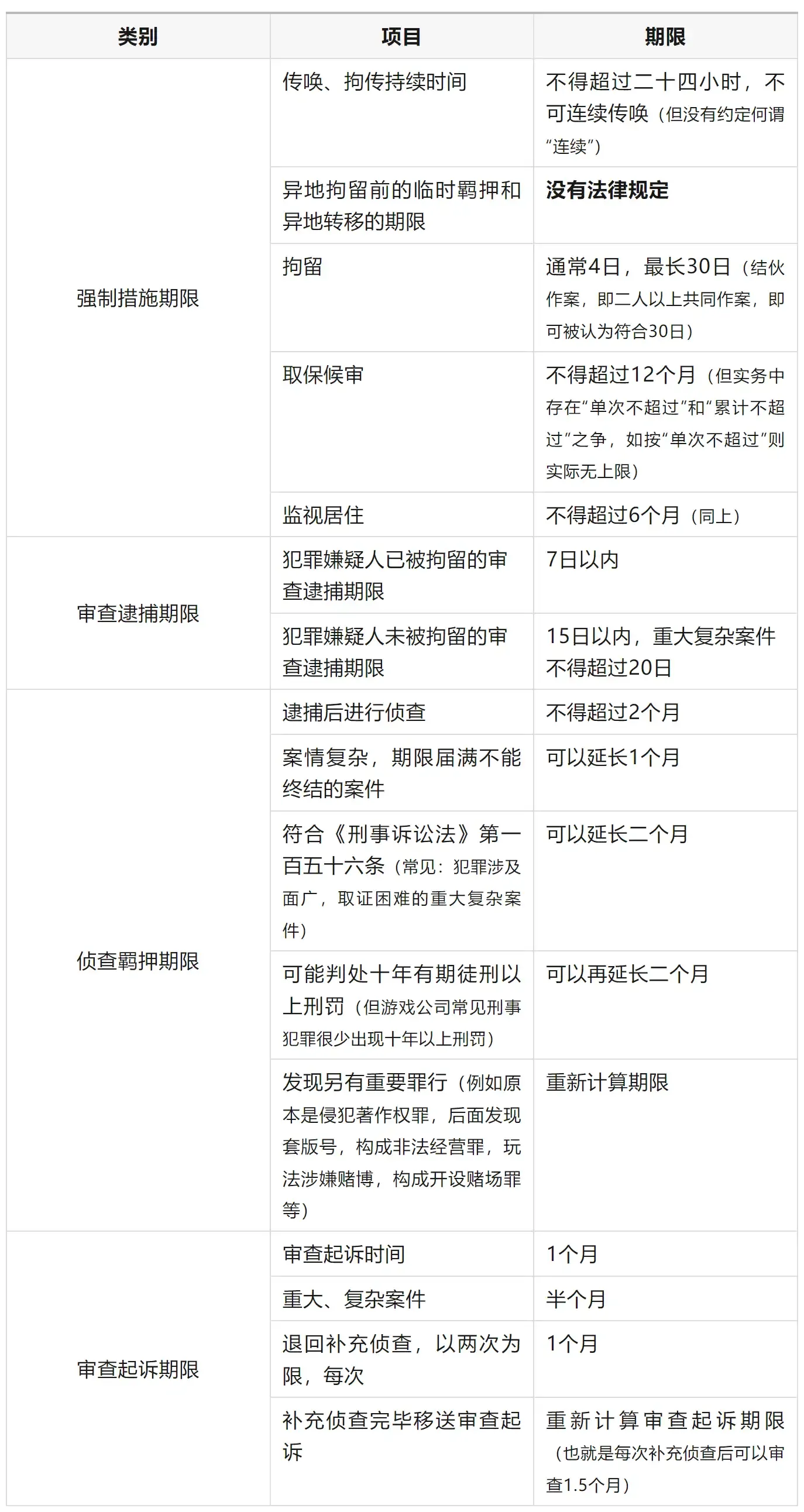
Assuming the procuratorate最终 decides not to prosecute, a “full” cross-regional case handling experience would roughly follow this流程:
-
Public security authorities from another jurisdiction arrive locally;
-
Summons/forcible summons (24 hours);
-
If clear criminal suspicion is found, a decision to detain is made, and the suspect is sent to a local detention center within 24 hours (the duration of temporary custody is indefinite, with no legal time limit, until the public security authority from the other jurisdiction completes relevant procedures and is ready to return to the jurisdiction);
-
After an indefinite period of travel, finally arrives at the jurisdiction;
-
During detention (30 days), the suspect undergoes multiple interrogations by the case-handling public security authority;
-
The public security authority believes there is criminal evidence and formally submits an arrest review request to the procuratorate;
-
The procuratorate conducts a review within the time limit (7 days), finds the facts unclear, and does not approve the arrest;
-
The public security authority believes further investigation is needed, so the compulsory measure is changed to residential surveillance (6 months);
-
Before the residential surveillance period expires, the public security authority submits another arrest review request; the procuratorate reviews again (7 days) and approves the arrest;
-
Due to the complexity and gravity of the case, the public security authority conducts sufficient investigation after the arrest (2+1+2=5 months, provided no other major crimes are discovered), then submits it to the procuratorate for prosecution review;
-
The procuratorate considers it a重大 complex case, conducts a sufficient review (1.5 months), determines that evidence is currently insufficient, and decides to return the case for补充 investigation;
-
The public security authority conducts the first补充 investigation (1 month) and submits the case again for review;
-
The procuratorate conducts another sufficient review (1.5 months), finds the evidence still insufficient, and returns the case for补充 investigation again;
-
The public security authority conducts a second补充 investigation (1 month) and submits the case once more for review;
-
The procuratorate conducts another sufficient review (1.5 months), finds the evidence still insufficient, and ultimately issues a decision not to prosecute;
-
Upon receiving the decision not to prosecute, the suspect is finally released from the local detention center and can return home that same day.
V. Company Property Issues During Cross-Regional Case Handling
In theory, the public security authority has the right to seize, impound, and freeze property related to criminal gains, with corresponding treatment based on the final trial result or prosecution result.
In the Notice of the Ministry of Public Security on Further Strictly Regulating Case Handling Cooperation in Accordance with the Law, the following provisions are also stated:
For enterprises that are suspected of crimes but are still in normal production and operation, compulsory investigative measures such as seizure, impoundment, and freezing shall be cautiously used to minimize adverse impacts on the enterprise’s normal production and operation. If seizure, impoundment, or freezing is indeed necessary, a strict distinction shall be made between illegal gains, other involved property, and legitimate property, and seizure, impoundment, and freezing beyond authority, scope, amount, or time limit are prohibited.
For property in the financial accounts of involved persons or enterprises, only freezing measures may be taken in accordance with the law. Transferring, or otherwise disguised形式 of seizure of such property is strictly prohibited.
For property in accounts that have been illegally seized, the public security authority shall return it through original channels; if a higher-level public security authority finds that a lower-level public security authority has illegally seized property, it shall order the lower-level authority to return it through original channels. If it is verified through review to be involved property, freezing measures may be taken in accordance with the law.
Notice of the Ministry of Public Security on Further Strictly Regulating Case Handling Cooperation in Accordance with the Law
However, in practice, for example, in the “Banban” blind box case, according to a report by China Business News, during cross-regional case handling, the Shunde Public Security Authority:
Brought together financial personnel分别 held in detention centers in Nanhai District and Sanshui District, requiring them to transfer over 300 million yuan from the bank accounts of Changxiangban Company and related companies entirely into the account of the Shunde Public Security Sub-bureau. Approximately 20 million yuan of the company’s shareholders’ personal funds were also transferred.
Some large fixed deposits were prematurely redeemed, resulting in nearly 3 million yuan in interest losses alone.
China Business News
Therefore, there is also a possibility that funds in company accounts and shareholders’ personal funds may be deemed involved property and transferred away collectively.
VI. Brief Summary
There is still much legal knowledge related to gaming criminal offenses. Due to space limitations, this article only briefly touches on some issues that the author believes are of greatest concern to readers in the game industry.
Cross-regional, especially跨-multiple-province case handling, although already present in the game industry, has increasingly become mainstream in the past year.
It appears to be largely replacing previous normal business competition and常规 civil litigation.
As competition in the game industry further intensifies, and gaming criminal laws and regulations become more完善 with increased law enforcement efforts, game enterprises should pay attention to this trend, actively adopt compliance measures, and establish sound legal risk prevention mechanisms to reduce their own legal risks.
At the same time, we should also call on relevant authorities to strengthen standardized management of cross-regional case handling to protect the legitimate rights and interests of game enterprises.
The prospects for the game industry remain bright, but it is clear that there are also more challenges. Only by continuously enhancing legal awareness and strengthening compliance management can one win in the fierce competition.
Recommended Previous Articles