Game User Acquisition Methods Urgently Need Further Compliance | Interpretation of the Interim Regulations on Anti-Unfair Competition on the Internet for the Game Industry
An analysis of the 2024 Interim Regulations on Anti-Unfair Competition on the Internet and their impact on common game user acquisition practices, including shell apps, trademark misuse, fake reviews, and price discrimination, with penalty provisions.
Preface
On May 11, 2024, the State Administration for Market Regulation issued the Interim Regulations on Anti-Unfair Competition on the Internet (hereinafter “the Regulations”), effective from September 1, 2024.
The Regulations consist of 43 articles, comprehensively listing unfair competition practices in the current online environment within the framework of the Anti-Unfair Competition Law, the E-Commerce Law, and the Anti-Monopoly Law.
Among these are some common “clever tricks” seen in the game user acquisition process.
If compliance corrections are not made in a timely manner, severe penalties may follow after the Regulations are officially published.
This article will analyze and interpret the provisions of the Regulations that may relate to game operation and promotion, helping readers understand what is permissible and what is not in advance, thereby avoiding relevant compliance risks.
*This article reflects only the author’s personal views and does not constitute any legal advice or legal opinion.
1 “What Is Not Permissible”
Article 7 [Confusing Acts]
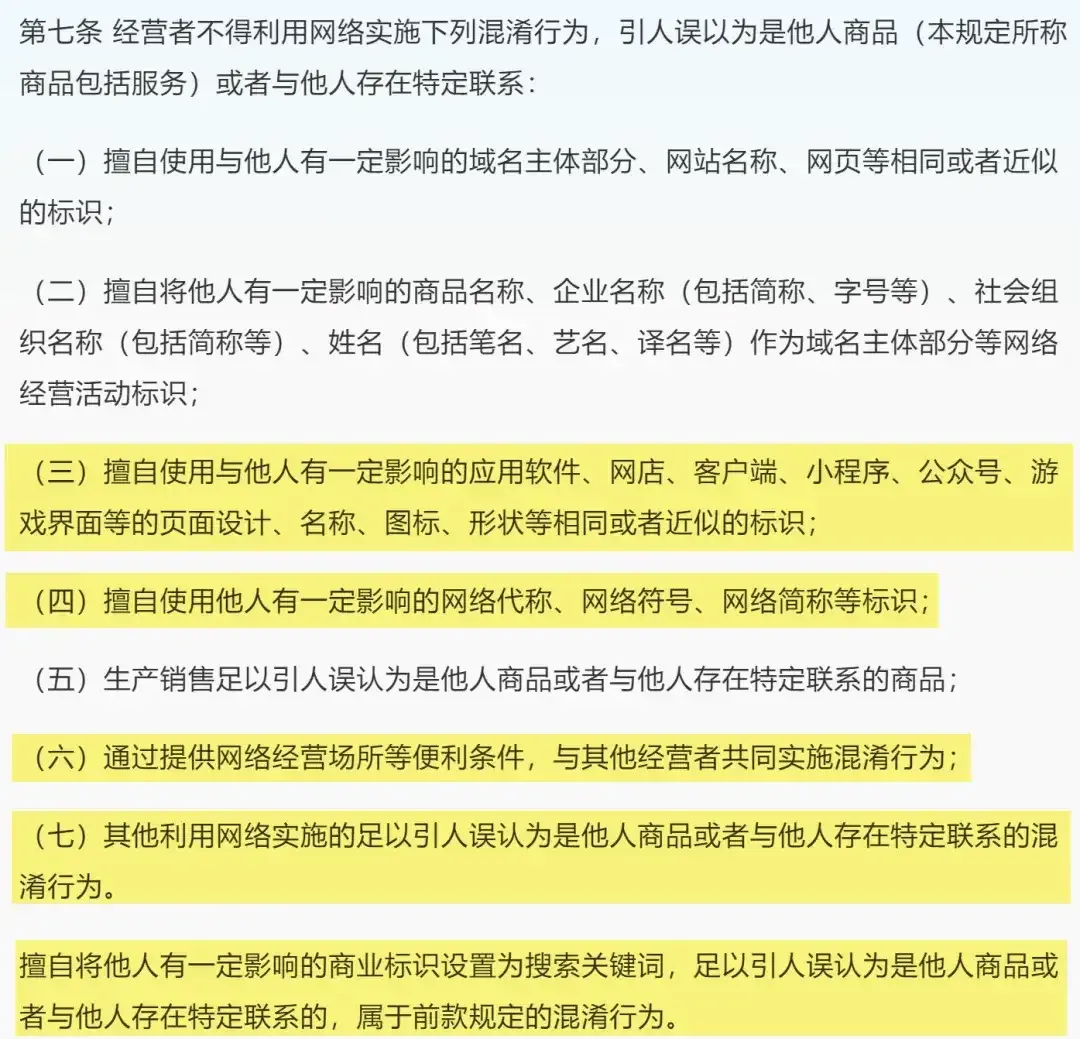
Paragraph (3)
Previously, the biggest problem in applying the Anti-Unfair Competition Law to the gaming field was that for confusing acts involving non-product names—such as game icons and UI—there was only the forced application of “trade dress,” but different courts and judges had different opinions on this.
Article 6: Business operators shall not implement the following confusing acts that cause others to mistake their goods for those of others or believe there is a specific connection with others: (1) Using without authorization identifiers that are identical or similar to another person’s product name, packaging, or trade dress that have a certain influence; Anti-Unfair Competition Law
The Regulations, Article 7, address this issue.
Paragraph (3) clearly defines the scope of protection, covering “application software” and “game interfaces,” as well as page designs and icons.
This means that previously possible practices of “borrowing” third-party materials (such as game icons, characters, game UI, etc.) to create shell app icons or promotional materials may not only constitute copyright infringement, but now also have clear legal provisions in the field of “unfair competition.” There is no longer any need to debate whether these fall under “trade dress.”
It is worth noting that since online games are also business activities conducted on the “internet,” game content is also subject to these regulations.
For acts of game asset plagiarism (especially UI parts), future application of the Anti-Unfair Competition Law will be more justified.
Paragraph (4)
What are nicknames and abbreviations?
In my opinion, for example:
【Abbreviations】
Red Alert → Red Alert
Age of Empires → Empire
World of Warcraft/Warcraft → Warcraft
Chinese Paladin → Paladin
Gu Jian Qi Tan → Gu Jian
【Nicknames】
World of Warcraft → WOW (Mount Hyjal/Shan Kou Shan)
World of Tanks → WOT (Shan Kou Ding)
The Elder Scrolls → Lao Gun (Old Scroll)
Elden Ring → Old Man Ring
PlayerUnknown’s Battlegrounds → Chi Ji (Eat Chicken)
League of Legends → LOL (Lu Ah Lu)
World of Warships → WOWS (Wo Wo Shi)
In the past, the Anti-Unfair Competition Law did not provide sufficient protection for folk nicknames and abbreviations of game products. The original law protected more of the “product name,” but many abbreviations and nicknames exist only among the public, passed down by word of mouth among players, and have become customary, rather than being registered or owned identifiers of the game product’s intellectual property owner, let alone the “official product name.”
With this clarification in the Regulations, as long as it can be proven that the abbreviation or nickname is sufficiently well-known and uniquely referential, improper use of related names may fall into the category of “unfair competition.”
Some common user acquisition practices in the past, such as “borderline” shell apps or promotional slogans (e.g., “Experience the authentic old scroll on your phone”), may likely be deemed unfair competition in the future.
Paragraph (6)
Platforms may also be deemed as “providing online business venues.” When receiving a notice of rights protection, it is recommended that platforms take action promptly to avoid being considered as “jointly implementing confusing acts.”
Paragraph (7)
The key point lies in the additional explanation section.
Setting another person’s well-known identifier (note: not product name) as a search keyword.
And the items listed in this paragraph are all identifiers.
This means that in addition to other games’ full names, game nicknames, abbreviations, etc., mentioned in this paragraph cannot be used as your own search keywords, otherwise it may constitute “unfair competition.”
How is it Punished
Article 18: If a business operator violates Article 6 of this Law by implementing confusing acts, the regulatory authorities shall order cessation of the illegal act and confiscate the illegal goods. If the illegal turnover exceeds 50,000 yuan, a fine of up to five times the illegal turnover may be imposed; if there is no illegal turnover or the illegal turnover is less than 50,000 yuan, a fine of up to 250,000 yuan may be imposed. If the circumstances are serious, the business license shall be revoked. Anti-Unfair Competition Law (same below)
Article 9 [False Publicity]
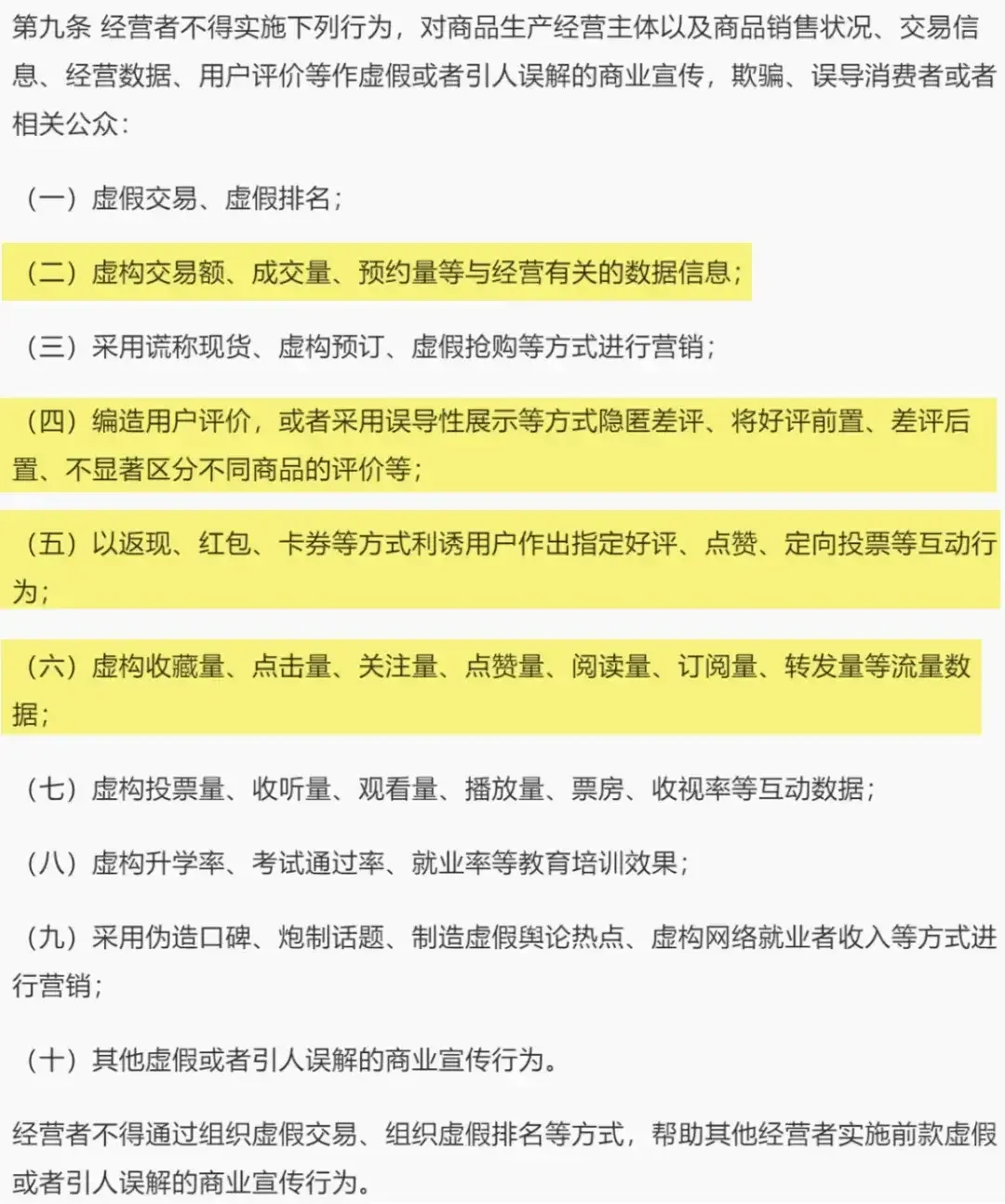
This article focuses on “false publicity.” The behaviors most relevant to the gaming industry are concentrated in “brushing volume” and “brushing positive reviews.”
“Brushing volume” includes but is not limited to:
Brushing pre-registration numbers: Inflated pre-registration numbers during the pre-launch phase of a game.
Brushing download numbers: Inflated download numbers during the operation phase of a game (including fixed download numbers manually entered on various landing pages).
Self-search: Repeatedly searching for a certain keyword and clicking search results to obtain higher relevance and search rankings through big data.
“Brushing positive reviews” includes “self-brushing comment sections” and “inducing users to write positive reviews” (five-star reviews for virtual currency/items).
All of these behaviors are violations.
Additionally, although the process of “self-recharging” may not be directly aimed at “consumers or the relevant public,” in terms of results, it also leads to higher nominations on various game lists, posing a risk of “unfair competition.”
How is it Punished
Article 20: If a business operator violates Article 8 of this Law by making false or misleading commercial publicity about its goods, or by helping other business operators make false or misleading commercial publicity through organizing false transactions or other means, the regulatory authorities shall order cessation of the illegal act and impose a fine of not less than 200,000 yuan but not more than 1,000,000 yuan; if the circumstances are serious, a fine of not less than 1,000,000 yuan but not more than 2,000,000 yuan shall be imposed, and the business license may be revoked. If the business operator’s violation of Article 8 of this Law constitutes the publication of false advertisements, punishment shall be imposed in accordance with the provisions of the Advertising Law of the People’s Republic of China.
Article 10 [Bribing Platforms]

The situation that constitutes this article is roughly:
Giving virtual currency/items (game recharge currency, monthly passes, premium accounts, etc.) to the administrator/moderator of a game forum, asking them to pay more attention to negative reviews, lock threads promptly, and hope that negative reviews about other companies can survive longer.
Although this may be a common “friendly cooperation” practice, it is sufficient to constitute a violation under this article.
How is it Punished
Article 19: If a business operator violates Article 7 of this Law by bribing others, the regulatory authorities shall confiscate the illegal gains and impose a fine of not less than 10,000 yuan but not more than 3,000,000 yuan. If the circumstances are serious, the business license shall be revoked.
Article 11 & Article 16 [Maliciously Attacking Competitors]
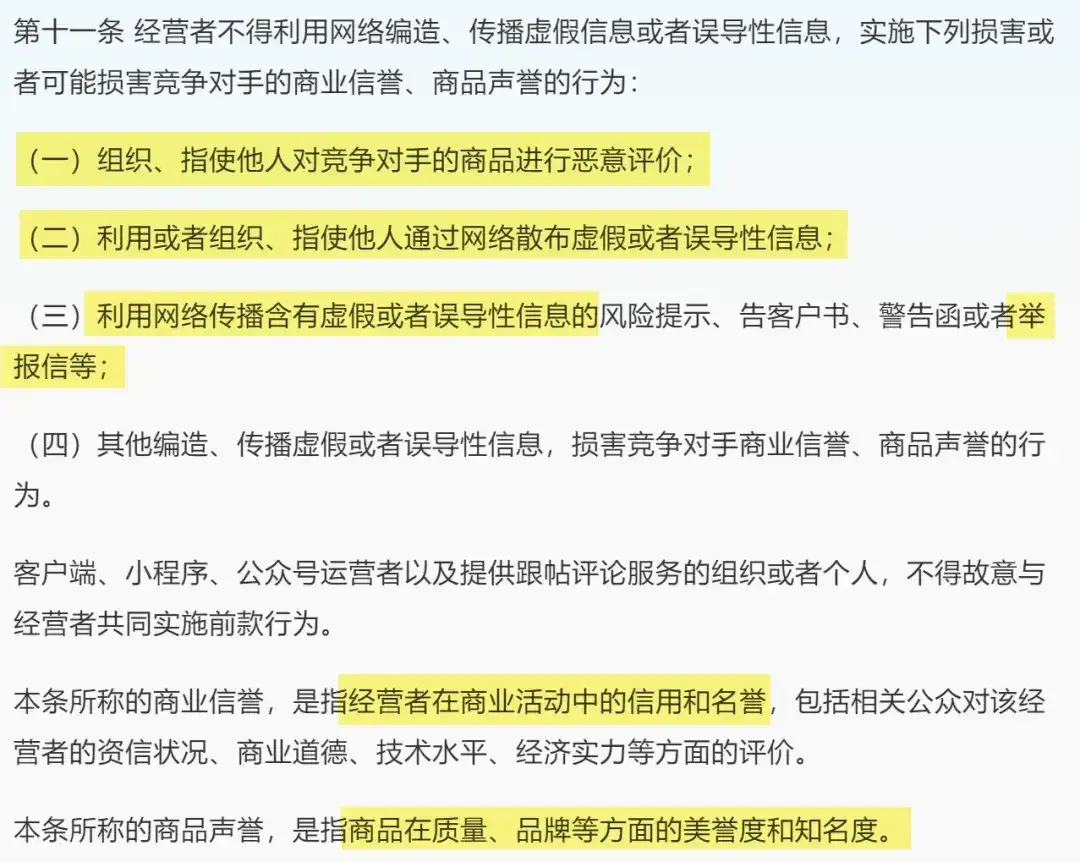
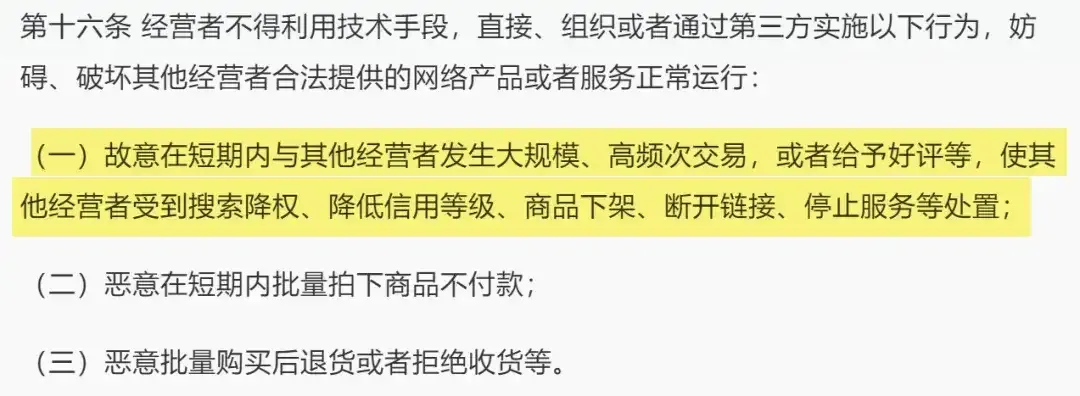
These two articles are related and are therefore discussed together.
Brushing Comments
Previously, in addition to brushing negative reviews, there have been cases where a game company would post obviously fake [poor-quality positive reviews] for competitors on platforms like App Store, causing the competitor to be sanctioned by the system.
This type of behavior has now been explicitly included in the category of unfair competition.
(Of course, finding evidence is still a major challenge.)
Spreading Rumors
Spreading false information is a common topic, but this time the inclusion of [complaint letters] is quite interesting.
In the past year or so in the gaming market, especially in the anime-style (ACG) market, there have been frequent instances where certain “players” publish a complaint letter to relevant authorities, claiming to be “setting an example” for other players and calling on them to file complaints together.
Such complaint letters often contain some overly exaggerated, one-sided, or misleading content. However, because they appear in the form of a “complaint letter,” they carry higher credibility in the eyes of uninformed passersby, causing great distress to the companies being “complained about” (regardless of whether the complaint is ultimately substantiated).
If it is verified to be a malicious act aimed at competitors, it may be considered unfair competition.
How is it Punished
Article 11: Article 23: If a business operator violates Article 11 of this Law by damaging the commercial reputation or product reputation of a competitor, the regulatory authorities shall order cessation of the illegal act, eliminate the impact, and impose a fine of not less than 10,000 yuan but not more than 500,000 yuan; if the circumstances are serious, a fine of not less than 500,000 yuan but not more than 3,000,000 yuan shall be imposed. Article 16: Article 24: If a business operator violates Article 12 of this Law by hindering or destroying the normal operation of network products or services legally provided by other business operators, the regulatory authorities shall order cessation of the illegal act and impose a fine of not less than 10,000 yuan but not more than 500,000 yuan; if the circumstances are serious, a fine of not less than 500,000 yuan but not more than 3,000,000 yuan shall be imposed.
Article 20 [Price Discrimination Against Existing Customers]
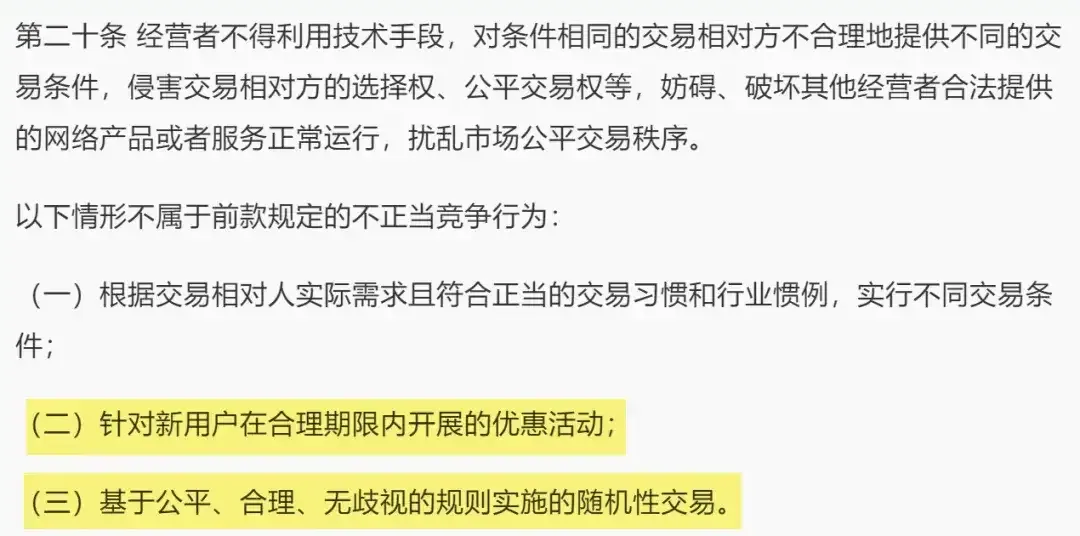
This article is more targeted at sales practices toward players.
For players under equivalent conditions (different VIP levels with different discounts may circumvent restrictions), different product/service prices cannot be designed.
In my opinion, this could also include setting different draw probabilities or other in-game probability settings for different players.
However, new player offers (double first recharge / increased first draw probability, etc.) and randomized transactions (randomly selecting players to receive a lower price) are not within the scope of restriction.
How is it Punished
Article 24: If a business operator violates Article 12 of this Law by hindering or destroying the normal operation of network products or services legally provided by other business operators, the regulatory authorities shall order cessation of the illegal act and impose a fine of not less than 10,000 yuan but not more than 500,000 yuan; if the circumstances are serious, a fine of not less than 500,000 yuan but not more than 3,000,000 yuan shall be imposed.
2 Simple Summary
So many provisions—let’s just simply summarize the main things you cannot do.
Cannot copy UI;
Cannot copy names;
Cannot copy folk abbreviations and nicknames;
Cannot brush volume (pre-registrations, downloads, recharge amounts, player counts, etc.);
Cannot offer “positive reviews for items/gold”;
Cannot brush positive reviews, cannot brush positive reviews for competitors, and cannot brush negative reviews for competitors;
Cannot give gifts to platform/forum employees, including game gift packs;
Cannot price discriminate against existing customers.
3 Other Notable Content
Article 17 [The Ad Blocker’s Nemesis]

My personal understanding is that this article is the nemesis of various ad-blocking plugins/software.
For [ad pages], although users strongly dislike them, for business operators, they still fall under their “legally provided information content and pages.”
Although there are three types of exceptions, a normal compliant ad page will necessarily have a “close button” (some may have one real button among several fake ones), and it is difficult to prove that the ad “frequently pops up.”
Therefore, developers of various ad-blocking plugins/software may all potentially constitute “unfair competition.”
Article 41 [Full Confiscation]

In addition to the [how it is punished] mentioned in the first part, all illegal gains, i.e.,
All revenue from the game
shall be confiscated.
4 Conclusion
The introduction of these Regulations demonstrates the legislative authorities’ growing familiarity with the market environment. Each provision is highly practical and addresses the pain points that previously “lacked legal support.” The attention and intervention of the legislative bodies indicate the importance placed on market order, prompting enterprises to pay more attention to compliance operations. This also means that “barbaric development” is gradually becoming a thing of the past.
Although the user acquisition market is beginning to cool down, I believe that some practitioners’ “ambitions” will not cool, and they may even become more eager to use “unexpected tactics” and “clever moves.”
However, with the prevalence of “confiscation,” the penalties for illegal and non-compliant behavior are continuously increasing. This trend gradually raises the cost of illegal behavior, and the old mindset of “do it first, worry about the risks later” will increasingly encounter obstacles.
Making money compliantly is what truly matters.